

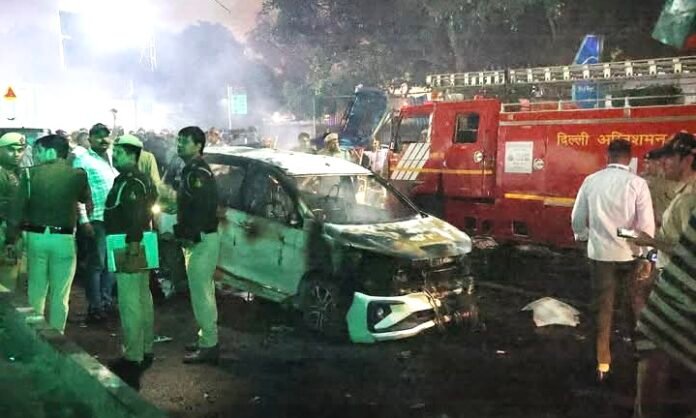
Indian authorities are probing potential connections between a deadly car explosion in the capital, New Delhi, and the arrest of seven men from the Kashmir region found in possession of weapons and bomb-making materials, according to three security sources familiar with the investigation.
The blast, which occurred on Monday evening near Delhi’s historic Red Fort, killed eight people and injured at least 20 others, marking the first major bombing in the capital since 2011. The explosion ripped through a busy evening market area, shattering shopfronts and scattering debris across one of Delhi’s most visited heritage sites.

Officials have not confirmed any group’s involvement but said the case is being investigated under India’s Unlawful Activities (Prevention) Act, the country’s primary anti-terrorism legislation.
Kashmir Connection Under Scrutiny
Just hours before the Delhi attack, police in Jammu and Kashmir announced the arrest of seven suspects, including two medical doctors, during coordinated raids across Kashmir, Haryana, and Uttar Pradesh. The men were allegedly part of a network of radicalized professionals linked to foreign handlers operating out of Pakistan, authorities said.
According to a statement from Kashmir Police, the raids uncovered two pistols, two assault rifles, and roughly 2,900 kilograms of bomb-making chemicals. Investigators believe the group maintained contact with members of the Pakistan-based militant organizations Jaish-e-Mohammad (JeM) and Ansar Ghazwat-ul-Hind, both of which have been accused of carrying out attacks inside India in the past.
“The probe points to a sophisticated white-collar terror ecosystem involving educated professionals and students,” the police statement said, suggesting that the suspects may have coordinated online with operatives based abroad.
Pakistan’s Foreign Ministry has not responded to India’s latest allegations. Islamabad has repeatedly denied supporting armed groups in Kashmir, saying it provides only diplomatic backing to what it calls a “legitimate freedom struggle.”
Search for the Delhi Blast Mastermind
Investigators are focusing on whether the driver of the car that exploded near the Red Fort had direct links to any of the recently arrested men. One source told Reuters that the car’s registration traced back to a Delhi-based medical practitioner, raising suspicions that the driver might have been connected to one of the detained doctors.
The National Investigation Agency (NIA), India’s top counterterrorism body, has now taken over the probe. Officials from both the NIA and Delhi Police declined to comment publicly, citing the ongoing investigation.
A senior home ministry official said forensic teams have recovered residue consistent with ammonium nitrate-based explosives, suggesting a professionally assembled device. Surveillance footage from the area reportedly shows the car being parked minutes before the explosion.
Massive Security Operation in Kashmir
In the aftermath of the Delhi blast, security forces in Kashmir launched widespread raids across several districts. A senior police officer told Reuters that hundreds of locations were searched, and more than 500 people were briefly detained for questioning. Most have since been released, though several remain under observation for suspected links to militant cells.
The crackdown follows a series of deadly incidents in the region this year. In April, at least 26 Hindu pilgrims were killed in a militant attack in southern Kashmir — an assault India blamed on Pakistan-backed groups. The attack triggered a brief but intense four-day military standoff between the two nuclear-armed neighbors before a ceasefire was restored.
Political Reactions and Security Concerns
Prime Minister Narendra Modi condemned the Delhi explosion, calling it a “cowardly act of terror,” and vowed that “no conspirator will be spared.” Senior cabinet ministers have convened multiple security meetings to review intelligence coordination between the capital and states bordering Kashmir.
The Delhi blast has reignited public concern about the resurgence of militancy beyond Kashmir, particularly in major urban centers. Analysts say the use of a civilian vehicle and commercial-grade explosives suggests a “low-cost, high-impact” operation designed to bypass conventional security systems.
“The incident signals a worrying shift — potentially involving new networks of radicalized urban professionals,” said Dr. Arvind Menon, a security studies expert at Jawaharlal Nehru University. “If links between Kashmir and Delhi are confirmed, it may indicate an evolving pattern of transregional coordination.”
Broader Regional Context
India and Pakistan have fought three wars since independence in 1947, two of them over Kashmir, a region both claim in full but govern in part. While insurgent violence in Kashmir has decreased in recent years, Indian intelligence agencies warn that foreign-backed sleeper cells could still operate across northern India.
As investigators piece together evidence from Monday’s blast, Delhi remains on high alert, with increased checkpoints, drone surveillance, and restrictions around key public sites.
For many residents, the attack has revived painful memories of earlier bombings in the capital — and renewed fears that the long-running conflict in Kashmir may once again be spilling into India’s heartland.
Source:Africa Publicity