

By Emmanuel Mihiingo Kaija
The Democratic Republic of Congo (DRC) is the custodian of the second-largest tropical rainforest on Earth, encompassing approximately 155 million hectares, with roughly 60% concentrated in the eastern provinces of Haut-Uele, Ituri, North Kivu, Tshopo, South Kivu, and Maniema. This forest complex forms part of the greater Congo Basin, which extends into Cameroon, Gabon, the Central African Republic, and the Republic of Congo. It functions as a carbon sink of global significance, storing an estimated 30 billion metric tonnes of carbon, roughly equivalent to three years of global fossil fuel emissions, and producing between 15–20% of Africa’s freshwater flow. Historically, the region has been exploited for centuries, first under colonial concessions in the early 20th century, during which Belgian companies systematically harvested African mahogany, Sapelli, and Okoume, often using forced labor. Today, illegal logging dominates the landscape, with high-value hardwoods such as African mahogany (Entandrophragma cylindricum), Sapelli (Entandrophragma utile), Okoume (Aucoumea klaineana), African teak (Milicia excelsa), Iroko (Milicia excelsa variant), Wenge (Millettia laurentii), Limba (Terminalia superba), and Sipo (Entandrophragma spp.) representing the majority of timber destined for East African markets.
Province-level extraction reveals stark disparities. In Haut-Uele, approximately 180,000–200,000 cubic meters of timber are illegally harvested annually, primarily Sapelli and Okoume. Ituri Province is the largest hotspot, producing 500,000–600,000 cubic meters annually, dominated by African mahogany and Wenge. North Kivu contributes 350,000–400,000 cubic meters, with a mix of African teak and Limba. Tshopo and Maniema, with more remote forests, generate 300,000–350,000 cubic meters, heavily weighted toward mahogany and Sapelli. The size of felled trees ranges from 0.4 to 1.5 meters in diameter, with lengths of 6–12 meters, yielding between 2 and 5 cubic meters of timber per tree. Secondary species, such as Sipo and Limba, are increasingly targeted as high-value stocks decline, reflecting an ongoing progressive depletion of forest quality.
q
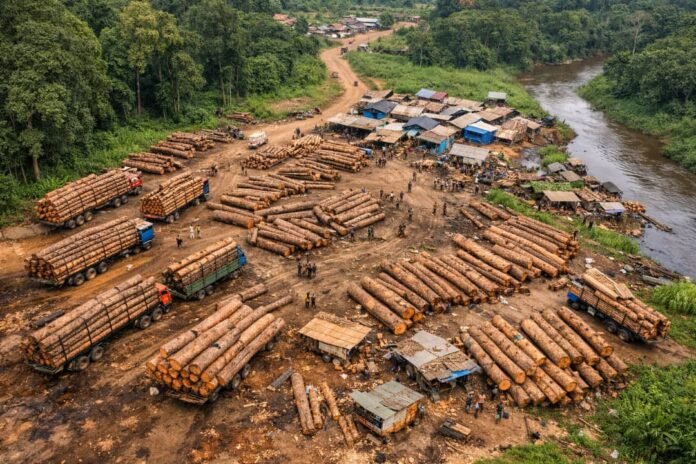
Artisanal logging operations dominate extraction. Approximately 8,000 loggers work in small gangs of 5–15 people, often under extremely hazardous conditions. Chainsaw-related injuries occur at an estimated 12–15% per year, while the combination of poor nutrition, tropical diseases, and exposure to vector-borne illnesses increases mortality risk among workers. Timber is initially processed at forest camps 5–30 km from primary roads, air-dried from 40–60% moisture to around 20%, and transported to intermediate hubs by motorbike, canoe, or rudimentary trucks, depending on terrain. These hubs, including Bunia, Butembo, Kisangani, and Isiro, serve as consolidation points where logs are sorted by species, quality, and size before being transported to border towns such as Lia, Kasindi, Goma, and Mpondwe. Each truck carries 25–40 cubic meters, valued between USD 4,500–8,000, depending on species, with forged documentation routinely used to mask the illegal origin.
Trafficking routes are highly structured yet clandestine. Logs from Bunia travel north through bush roads to Lia (Uganda border) and east via river systems to Kasindi. From Butembo, timber is ferried west to Goma (Rwanda border) and south to Mpondwe (Uganda border). Trucks often carry 600–700 planks per shipment, disguised under sacks of maize, beans, or other agricultural products. Once in East African markets, timber enters Kampala, Nairobi, Kigali, and Dar es Salaam, where it is transformed into furniture, veneer, or construction planks. Informal tolls and bribes along these routes account for 10–15% of shipment value, with each truck paying an average USD 1,000–1,200 in bribes, highlighting the scale of systemic corruption facilitating the trade.
Economic incentives are enormous. Dealers report annual net incomes of USD 12,000–18,000, local loggers earn USD 500–1,200, and transporters USD 1,000–1,500 per truckload, excluding bribes. INTERPOL and UNEP estimate that illegal timber exports generate over USD 800 million annually, or roughly 20% of the formal forestry sector, with the inclusion of charcoal, secondary products, and untracked timber likely pushing the informal economy above USD 1.25 billion per year. Timber trade profits are disproportionately concentrated at the middle and end of the supply chain, while local communities, largely excluded, endure environmental degradation and social disruption.
Ecological and environmental consequences are catastrophic. Deforestation rates in eastern DRC from 2010–2020 exceeded 1 million hectares per year, driven primarily by illegal logging and charcoal production. Forest fragmentation has led to population declines of endangered primates by 20–25%, large mammals by 15–20%, and bird species by 10–15% in heavily logged zones. The Congo Basin hosts approximately 10,000 tropical plant species, 30% endemic, with selective logging altering forest composition, seed dispersal patterns, and regeneration dynamics. Carbon sequestration losses are estimated at 200–250 million tonnes of CO2 per year, valued at USD 55 billion if monetized on global carbon markets. Soil erosion and river siltation impact 2.3 million residents, reducing arable land, affecting fisheries, and exacerbating food insecurity.
Governance challenges remain pronounced. Only 6% of 82 assessed concessions, covering 14.5 million hectares, fully comply with DRC forestry codes; 40% fail to meet surface tax obligations. The 2002 moratorium on new concessions is largely unenforced, while corruption at checkpoints allows trucks to move largely uninspected. CITES registration covers less than 15% of high-value hardwood exports, leaving millions of cubic meters unmonitored. Satellite monitoring and drone technology are sporadically deployed, with limited technical expertise and funding, leaving large areas vulnerable to illicit activity.
Human impacts are profound and interwoven with ecological damage. Communities face intimidation from loggers, coercion of youth into dangerous labor, and displacement from ancestral forest lands. Roughly 1.2 million residents are directly affected, with livelihoods tied to small-scale agriculture, hunting, and forest products. Malnutrition, increased exposure to disease, and social dislocation combine to form cycles of vulnerability and exploitation, while revenue from the timber trade rarely benefits local infrastructure or public services.
Species-specific extraction volumes and carbon loss (textual table):
African Mahogany: 1.2 million m³/year; carbon loss ~60 million t CO2e/year
Okoume: 0.4 million m³/year; carbon loss ~18 million t CO2e/year
Sapelli: 0.35 million m³/year; carbon loss ~15 million t CO2e/year
African Teak: 0.25 million m³/year; carbon loss ~10 million t CO2e/year
Wenge & Limba: 0.1 million m³/year combined; carbon loss ~5 million t CO2e/year
Projections indicate that eastern DRC forests may lose 15–20% of standing timber within the next decade under current extraction trends, pushing species toward functional extinction, causing cascading ecological and economic impacts, and jeopardizing regional climate stability.
References
1.African Development Bank (AfDB). Illicit Timber Trade Report. 2024. https://www.afdb.org/sites/default/files/documents/publications/illicit_timber_trade_report.pdf
2.Pulitzer Center on Crisis Reporting. Timber Hustling: Lia as a Trafficking Hub. 2024. https://pulitzercenter.org/stories/timber-hustling-lia-thriving-hub-congolese-mahogany-trafficked-uganda-kenya
3.Standard Media. Illegal Logging and Charcoal Trade Killing the Congo Rainforest. 2025. https://www.standardmedia.co.ke/health/amp/national/article/2001469500/illegal-logging-and-charcoal-trade-killing-the-congo-rainforest
4.The Brief. DRC’s Stolen Timber Trafficked to Kenya, Rwanda, TZ, and Uganda. 2025. https://thebrief.co.ke/eac/drcs-stolen-timber-trafficked-to-kenya-rwanda-tz-and-uganda
5.DR Congo Business. DRC’s Logging Industry Marred by Systemic Illegalities. 2024. https://www.drcongobusiness.com/article/751035624-drc-s-logging-industry-marred-by-systemic-illegalities-new-findings-show
6.UNEP. Illegal Logging and Forest Degradation in the Congo Basin. 2024. https://wedocs.unep.org/bitstream/handle/20.500.11822/22074/UNEP_DRCongo_MONUSCO_OSESG_final_report.pdf
7.The Star. From Congo to Kenya: The Long Journey of Mahogany. 2025. https://www.the-star.co.ke/news/2025-06-24-from-congo-to-kenya-the-long-journey-of-mahogany-2
8.FAO & ITTO. Congo Basin Forest Carbon and Biodiversity Statistics. 2023–2024. https://africacenter.org/wp-content/uploads/2024/11/ASB-44-EN-final.pdf