

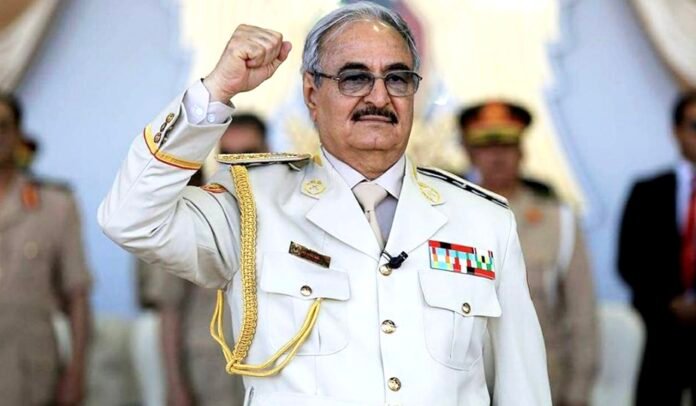
Libyan National Army (LNA) commander Field Marshal Khalifa Haftar has once again urged citizens across Libya to engage in peaceful, organized mobilisation aimed at breaking the country’s persistent political deadlock. His renewed appeal comes as the United Nations-backed political roadmap, introduced by envoy Stephanie Khoury, continues to show minimal progress toward long-delayed national elections.
Libya has been trapped in political limbo since the collapse of planned presidential and parliamentary elections in December 2021. Repeated international and domestic initiatives to bridge the divide between rival administrations — based in the east and west — have failed to deliver tangible results, leaving the country divided and frustrated.
Speaking during a meeting with elders and tribal leaders from the city of Bani Walid, Haftar emphasized that “Libyans must assume responsibility for their future through peaceful and lawful mobilisation to rebuild the state.” His remarks underscored growing dissatisfaction with international mediation efforts, which many Libyans perceive as ineffective.
Political analyst Kamel Al-Marash explained that Haftar’s renewed message signals a strategic shift toward internal consolidation. “Haftar appears to be seeking broader popular legitimacy by engaging local communities, particularly tribal leaders, to counterbalance external interference and the stagnation of the UN-led dialogue,” Al-Marash said. He added that the commander’s tone suggests a readiness for the LNA to play a more active political role if such public backing materializes.
Over recent weeks, Haftar has intensified his outreach, meeting with tribal figures, municipal officials, and political representatives across Libya’s eastern, southern, and central regions. Observers see these efforts as part of a wider campaign to create a unified domestic front amid widespread disillusionment with the international peace process.
Another Libyan political expert, Mohammed Saleh Al-Obeidi, warned that the prolonged stalemate risks deepening the country’s institutional decay. “If political paralysis continues, Libya faces the real danger of further fragmentation, economic deterioration, and rising corruption,” he said.
Al-Obeidi noted that Haftar’s latest call aims to increase public and political pressure on both Libyan factions and international stakeholders to move toward a negotiated solution that prioritizes stability and sovereignty. “The message is clear — time is running out, and Libyans must reclaim the initiative before external actors dictate their future,” he concluded.
Washington Cancels VP Vance’s Nairobi Trip After US Pulls Out of South Africa G20
Source:Africa Publicity