

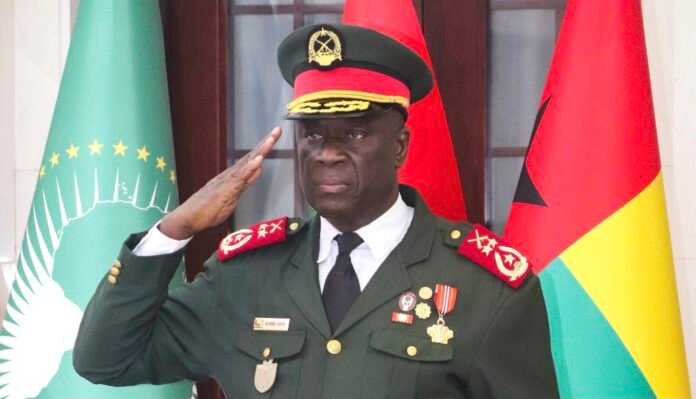
Two weeks after overthrowing the civilian government, Guinea-Bissau’s ruling military authorities have issued a detailed transition charter that outlines a one-year path back to constitutional rule — but prevents the interim president and prime minister from competing in the next national elections.
The 12-month framework, published Tuesday, lays out new political rules for the West African nation following the November 26 coup that halted electoral proceedings and suspended the constitution. The 29-article document sets the stage for the restoration of elected governance, though under strict oversight of the military commanders who seized power.
Election Timeline Set for Late 2025
According to the charter, both presidential and legislative elections must be held at the end of the one-year transition period. The exact election date will be chosen by the transitional president, Major-General Horta Inta-a, who assumed power on November 27 after the coup that removed President Umaro Sissoco Embaló from office.
The transition government also appointed Ilidio Vieira Té, a civil servant and former finance minister, as prime minister one day after installing Inta-a as interim head of state. The charter explicitly bars both men — and all other transitional officeholders — from running in the upcoming elections, a rule intended to prevent incumbents from using transitional authority to influence future contests.
Military High Command Retains Broad Powers
The officers who orchestrated the coup refer to themselves as the Military High Command. Under the transition charter, this body will play a dominant role in restructuring the country’s political institutions. It is tasked with directing legal reforms, rewriting sections of the suspended constitution, and supervising changes to the country’s multi-party system.
The charter also gives the Military High Command authority to oversee the creation of a new Constitutional Court, appoint new electoral officials, and propose changes that will shape Guinea-Bissau’s governance in the years ahead. Decisions made during this period must be validated by the transitional government but are expected to reflect strong military influence.
Transitional Legislature Established
To manage lawmaking during the transition, the charter creates a 65-member National Transition Council (NTC). The NTC will serve as an interim legislative assembly, replacing the dissolved National People’s Assembly. Ten of its members will be senior army officers representing the Military High Command, while the remaining seats will be filled by political groups, civil society organizations, and regional representatives.
This arrangement, according to the document, is intended to ensure “broad national participation,” though critics say it places disproportionate power in the hands of the military leadership.
Coup Disrupted Election Results Announcement
The November 26 coup occurred just one day before Guinea-Bissau’s electoral commission was expected to release official results from presidential and parliamentary elections. The Military High Command accused the outgoing government of mismanagement and alleged irregularities in the voting process — claims that have not been independently verified.
Guinea-Bissau has faced chronic political instability since independence from Portugal in 1974. The country has experienced multiple coups, attempted coups, and periods of military rule, with only one president in its history completing a full constitutional term.
Regional Parallels and Concerns
Analysts have noted the similarities between Guinea-Bissau’s situation and developments in nearby Guinea, where a military coup in 2021 also led to a transitional charter barring coup leader Mamady Doumbouya from contesting future elections. However, Guinea later adopted a new constitution in September that removed this restriction. Doumbouya is now a declared candidate in the election scheduled for December 28, raising concerns about military leaders using transitional periods to entrench power.
Regional bodies such as ECOWAS and the African Union have yet to release detailed reactions to Guinea-Bissau’s newly announced charter, though both organizations have previously expressed concern about democratic backsliding and rising military influence across West Africa.
A Nation Awaiting Stability
The one-year transition now begins against a backdrop of political uncertainty and public expectation. Many residents hope the charter will provide a framework for stability after years of turmoil, while others fear the military may prolong its role in governance beyond the timeline it has set.
Source:Africa Publicity