
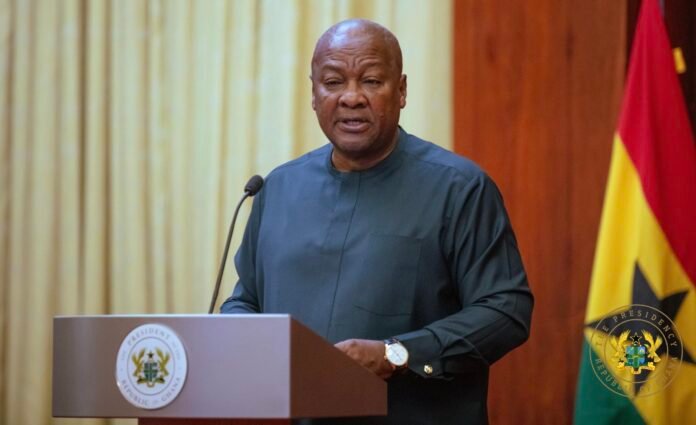
Ghana recorded notable macroeconomic improvements in the first year of President John Dramani Mahama’s administration, with lower inflation, faster economic growth, easing interest rates and a sharply stronger currency pointing to a period of stabilisation after years of economic strain.
Growth gains across key sectors
Data from the Ministry of Finance show that Ghana’s economy expanded by 6.1 per cent in the first three quarters of 2025, up from 5.7 per cent over the same period in 2024. This represents the country’s strongest growth performance since 2019.
Growth was even more pronounced outside the oil sector, which tends to be more capital-intensive. Non-oil GDP grew by 7.5 per cent, reflecting stronger activity in agriculture, services, construction and manufacturing — sectors that collectively employ the majority of Ghanaians.
Inflation drops to multi-year low
One of the most significant developments of the year was the sharp fall in inflation. Headline inflation declined from 23.8 per cent in December 2024 to 6.3 per cent by November 2025, the lowest level in nearly six years.
Both food and non-food inflation eased considerably, helping to reduce pressure on household incomes and improve purchasing power. The disinflation trend also reflected tighter monetary conditions earlier in the cycle, improved exchange rate stability and easing supply-side pressures.
Borrowing costs ease
Lower inflation translated into a sharp fall in interest rates across the money market. Treasury bill rates dropped from above 30 per cent at the end of 2024 to around 11 per cent in 2025, significantly cutting government borrowing costs.
The decline in rates also improved liquidity conditions in the banking system and reduced debt servicing pressures, creating more room for private sector credit expansion.
Cedi posts strongest performance in years
On the foreign exchange front, the Ghana cedi recorded its best annual performance in years, appreciating against all major trading currencies.
As of December 31, 2025:
• The cedi gained 40.7 per cent against the US dollar
• Rose 30.9 per cent against the British pound
• Appreciated 24 per cent against the euro
The currency gains were supported by improved foreign exchange inflows, stronger export receipts, better market confidence and tighter macroeconomic management.
External buffers strengthen
Ghana’s external position also improved markedly. By the end of October 2025, the trade balance posted a surplus of $8.5 billion, driven by higher export earnings and more restrained import growth.
Gross International Reserves stood at $11.41 billion, equivalent to 4.8 months of import cover, providing a stronger buffer against external shocks and enhancing investor confidence.
Improved credit outlook
Reflecting these developments, Fitch Ratings, Moody’s and S&P Global all upgraded Ghana’s sovereign credit ratings during the year. The agencies cited progress in fiscal consolidation, improved debt sustainability and strengthening macroeconomic stability.
Year defined by stabilisation
Overall, the first year of the Mahama administration was largely characterised by economic stabilisation — restoring price stability, strengthening the currency, rebuilding external buffers and supporting growth.
While structural challenges such as unemployment, productivity constraints and fiscal pressures remain, the data suggest that Ghana entered 2026 on a firmer macroeconomic footing than it had in recent years.
Source: Africa Publicity