
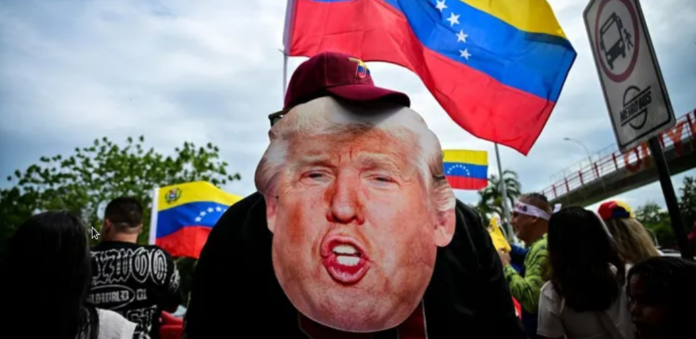
In an unprecedented escalation of global tensions, the United States has begun a temporary administration of Venezuela following a massive military operation that resulted in the capture of President Nicolás Maduro and his wife, Cilia Flores.
While the White House maintains the “spectacular assault” was a counter-narcotics mission, a growing chorus of international voices—led by the former South African Ambassador to Venezuela and supported by Russia and China—is labeling the move a violation of international law driven by a desire for Venezuela’s vast oil reserves.
The ‘Oil and Power’ Narrative
Former South African ambassador to Venezuela, Bheki Gila, has dismissed the U.S. justification of “narco-terrorism” as a smokescreen. Gila attributed the strike directly to Venezuela’s status as holder of the world’s largest proven oil reserves, describing the operation as a blatant fight for resources and regional dominance.
“The U.S. will quickly secure the oil reserves and gold mines,” Gila stated, predicting that the naval blockade would remain as a deterrent. “The American navy will not leave there, just to scare the daylight out of anyone else who tries something.”
Political analyst Professor Theo Neethling expanded on this, noting that Venezuela’s oil industry was largely built by U.S., British, and Dutch capital in the 20th century before the 1976 nationalization. He argues the current operation is an attempt by Trump to “take back” an industry that collapsed due to mismanagement and underinvestment.
The Operation and New York Detention
Under direct authorization from President Donald Trump, U.S. forces launched a large-scale strike involving more than 150 aircraft, targeting military and government infrastructure in Caracas and the states of Miranda, Aragua, and La Guaira.
Captured during the raid, Maduro and Flores were transferred to the United States to face trial in the Southern District of New York. The former leader faces an indictment—originally issued in March 2020—on charges including:
- Narco-terrorism conspiracy
- Cocaine importation conspiracy
- Illegal possession of machine guns and destructive devices
President Trump announced that the U.S. would “run” the country until a “judicious transition” of power is arranged, adding that U.S. oil companies would be involved in refurbishing Venezuela’s energy infrastructure.
International Condemnation and Calls for UN Action
The diplomatic fallout has been swift and severe:
- Russia: The Kremlin condemned the “act of armed aggression,” urging the U.S. to reconsider its position and release the “legally elected president.”
- South Africa: The Department of International Relations and Cooperation (DIRCO) called for an urgent UN Security Council meeting. Spokesperson Chrispin Phiri described the U.S. actions as a “manifest violation” of the UN Charter, which mandates respect for the territorial integrity of sovereign states.
- China: Beijing demanded the immediate release of Maduro and his wife, urging Washington to stop its efforts to “topple the government of Venezuela.”
- India: The Ministry of External Affairs described the situation as a “matter of concern,” calling for a peaceful resolution through dialogue to ensure regional stability.
The Path Ahead
Political analyst Zakhele Ndlovu warned that the U.S. is sending a “scary message” to the world: “If one threatens its interests, then one is not safe.”
As Caracas remains under a heavy U.S. military presence, the international community is bracing for a protracted legal and diplomatic battle. While Washington promises an orderly handover to new leadership, the presence of U.S. oil interests at the heart of the transition has fueled fears that the “temporary” administration may become a long-term occupation of South America’s most resource-rich nation.
Source: AFP
Related Posts:
INDIA: Massive Protests Rock Dehradun as Fresh ‘VIP’ Allegations Revisit Ankita Bhandari Murder Case
Maduro Detained in New York as Russia Urges Immediate Release Following US Takeover of Venezuela
Canada Deported 366 Nigerians in 10 Months: Analysis of the 2025 Immigration Enforcement Surge