

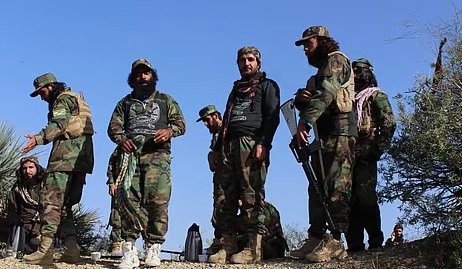
At least four civilians and one soldier were killed in renewed fighting along the Afghanistan–Pakistan border following an overnight exchange of gunfire and shelling near the busy Chaman–Spin Boldak crossing, Afghan officials confirmed on Saturday, December 6. The incident marks the latest breakdown in security in the volatile border region, despite a ceasefire that was agreed upon weeks earlier after a series of deadly clashes.
Hamdullah Fitrat, a spokesperson for the Afghan authorities, said that in addition to those killed, at least five other civilians were wounded during the exchange. On the Pakistani side of the border, a hospital in the town of Chaman reported that three people were treated for minor injuries as a result of the fighting.
The clash occurred late at night in an area that has, for years, been a flashpoint between the two neighbouring countries. Residents on both sides reported hearing heavy firing that lasted for approximately two hours, beginning around 10:30 p.m. local time. The sound of gunfire and explosions caused widespread panic, with families struggling to find safe shelter in their homes.
Both governments have accused each other of starting what they described as an “unprovoked” attack. A Taliban spokesperson, Zabihullah Mujahid, claimed on the social media platform X that Pakistani forces had launched the first assault in the Spin Boldak district of Kandahar province. He said that Taliban forces, referred to as the “Islamic Emirate,” were forced to respond in self-defence.
In response, Pakistan rejected the accusation, stating that Afghan forces initiated the shooting. Mosharraf Zaidi, a spokesperson for Pakistan’s prime Minister, insisted that the Afghan Taliban forces “resorted to unprovoked firing,” placing responsibility for the escalation on the Afghan side.
Ali Mohammed Haqmal, head of Kandahar’s information department, alleged that Pakistani forces used both light and heavy artillery during the confrontation and that some mortar rounds landed in residential areas. According to him, several homes were struck during the exchange, worsening fears among local communities already accustomed to instability.
Residents in the area described a terrifying experience. Mahmood Khan, a local man living near the border, said the incident escalated quickly. According to him, what began as lighter gunfire soon turned into heavier attacks involving tanks and mortars. He reported that members of his own family were injured during the shelling. Another resident, identified as Shamsullah, said his brother was killed as he attempted to move to a safer part of the house during the bombardment.
On the other side of the border in Pakistan, labourer Muhammad Naeem said that mortar shells struck homes and nearby open areas, forcing many families to hide indoors. He explained that while some residents tried to flee, the intensity of the gunfire made movement too dangerous, leaving people trapped inside their houses until the fighting subsided.
The latest violence highlights the increasingly fragile relationship between Pakistan and Afghanistan, which has deteriorated significantly since the Taliban returned to power in Kabul in 2021. Pakistan has repeatedly accused the Taliban-led government of providing safe haven to militants from the Pakistani Taliban, also known as the Tehreek-e-Taliban Pakistan (TTP), who have carried out attacks on Pakistani security forces and civilians. The Taliban authorities have denied these allegations, insisting that they do not allow Afghan territory to be used for attacks on neighbouring countries.
Tensions reached a peak in October, when fierce clashes along the same border reportedly killed more than seventy people, including civilians and combatants. Following international concern, mediation efforts by Qatar and Turkey resulted in a ceasefire agreement, raising hopes for a reduction in violence. However, ongoing incidents and mutual distrust have prevented any long-term resolution, and the border has largely remained closed to regular movement.
Last month, Afghan officials accused Pakistan of conducting airstrikes inside Afghan territory that reportedly killed ten civilians, including nine children. Pakistan strongly denied carrying out the airstrikes and, in turn, warned that the existing ceasefire was “not holding” due to continued attacks by armed groups believed to be operating from Afghan soil.
Despite the instability, Pakistan announced earlier this week that it planned to partially reopen the Chaman border crossing for limited purposes, including the delivery of humanitarian aid by the United Nations. According to Mosharraf Zaidi, those plans remain in place, as the movement of aid is considered separate from political and military tensions.
Security analysts warn that without a clear and jointly enforced border agreement, such incidents are likely to continue. The region, which is marked by difficult terrain and divided tribal communities, has long been a source of friction between the two countries. Frequent closures, sudden clashes, and lack of coordinated border management have left local residents living in constant uncertainty.
For civilians living near the frontier, the impact is not just political, but deeply personal. Families face damaged homes, disrupted livelihoods, and the constant fear of renewed violence. Traders and workers who depend on cross-border movement have seen their income disappear as access to the border remains unpredictable.
As both sides trade blame over the latest deaths, calls are growing for renewed diplomatic engagement and stronger international mediation to prevent further loss of life. For now, however, the Afghan–Pakistan border remains one of the tensest and most dangerous frontiers in the region, with ordinary people bearing the heaviest cost of an unresolved conflict.
Source:Africa Publicity