

By: Isaac Christopher Lubogo
Abstract
This discourse examines the legal, regulatory, and jurisprudential tensions surrounding Uganda’s mature age entry (MAE) framework, focusing on the paradox that while a MAE certificate expires after two years for electoral qualification purposes, a university degree obtained through that same MAE pathway remains permanently valid. The study analyses the statutory architecture under the Universities and Other Tertiary Institutions Act, the Parliamentary Elections Act, and Legal Notice No. 12 of 2015, which imposes a mandatory two-year validity window for MAE certificates when used as equivalents to the Uganda Advanced Certificate of Education. Through authoritative case law—including Mwiru v Nabeta, Gole v Kiryapawo, Nakendo v Mwondha, Mbabaali, and jurisprudential commentary from the Lubwama litigation—the analysis demonstrates that Ugandan courts consistently distinguish between admission routes, which may be time-bound, and final qualifications, which are not.
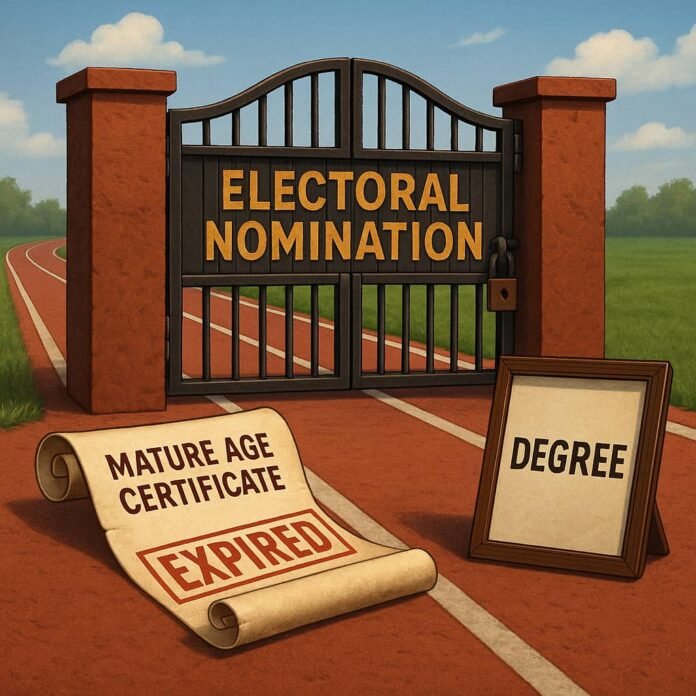
The central finding is that Walukaga’s degree remains legally valid because Ugandan courts do not invalidate completed university qualifications unless fraud is proven, and they refrain from “sitting in academic judgment” over institutional awards. The expiry of the MAE certificate does not retroactively nullify the legitimacy of his degree, since it is a self-standing academic qualification awarded by an accredited university under NCHE supervision. However, the same degree cannot rescue his 2025 electoral bid because he did not present it for nomination; instead, he relied on an MAE certificate that had already expired under the binding provisions of Legal Notice 12/2015. As a result, his nomination was legally defective despite the continuing validity of his degree.
Importantly, this creates a future opportunity for Walukaga: he may rely on his degree—as opposed to the expired MAE certificate—in subsequent electoral cycles, since degrees do not expire and satisfy Article 80 of the Constitution independently of entry routes. The law therefore closes the gate to his current nomination but leaves open the broader electoral pathway for future contests. This analysis exposes the sharp, necessary distinction between qualification as an academic fact and qualification as an electoral legal requirement, showing that while the MAE certificate is constrained by statutory time, the university degree remains a durable and legally sufficient credential for future political participation.
1. Introduction
The mature age entry (MAE) pathway occupies a distinctive space at the intersection of higher education regulation, university autonomy, and electoral law in Uganda. Although universities conduct mature age examinations under accreditation from the National Council for Higher Education (NCHE), the value and legal effect of the mature age certificate vary significantly depending on the legal context in which it is invoked. This discourse evaluates the jurisprudence and regulatory framework surrounding MAE certificates, particularly focusing on: (i) the two-year validity rule introduced under Legal Notice No. 12 of 2015; (ii) the authority and limits of universities vis-à-vis NCHE and UNEB; (iii) jurisprudential boundaries established by Ugandan courts; and (iv) implications for electoral qualification under Article 80 of the Constitution.
2. Legal and Regulatory Foundations of Mature Age Entry
2.1 NCHE’s Statutory Mandate
The Universities and Other Tertiary Institutions Act 2001 (UOTIA) establishes NCHE as the primary regulator of higher education, empowered to set minimum admission standards, accredit academic programmes, and supervise quality assurance in universities (UOTIA, ss 4, 5, 119). This includes authority to approve mature age examinations conducted by accredited universities (NCHE, Quality Assurance Framework, 2008).
2.2 Minimum Admission Requirements
The NCHE Minimum Admission Requirements Regulations recognise MAE as a lawful entry route for candidates aged 25 years and above who pass the examination with a minimum score of 50% (NCHE, 2008). These standards apply across all accredited universities.
2.3 The Election-Law Dimension: Legal Notice No. 12 of 2015
For electoral purposes, the pivotal instrument is Legal Notice No. 12 of 2015, titled Universities and Other Tertiary Institutions (Equating of Qualifications) (Amendment) Benchmarks, 2015.
Paragraph 9(b) stipulates:
“A certificate awarded to a person who has sat and passed the mature age entry examinations with at least 50% shall be valid for two years from the date of award for purposes of determining equivalence to the Uganda Advanced Certificate of Education.”
(LN 12/2015, para 9(b)).
This is a binding statutory instrument issued under the UOTIA and incorporated into the framework of the Parliamentary Elections Act (PEA) and the Presidential Elections Act, which require the Electoral Commission (EC) to rely on NCHE and UNEB for verification of academic qualifications (PEA, s 4(6)–(7)).
NCHE officials have repeatedly affirmed this two-year validity in public clarifications (NCHE Press Briefing, Nov 2025).
3. Distinguishing the Three Tiers of Academic Documentation
Ugandan jurisprudence recognises a crucial distinction between:
1. The Mature Age Entry Certificate – an admission route, time-bound under LN 12/2015 for electoral equivalence.
2. NCHE’s Certificate of Equivalence – issued under PEA s 4(6) after consultation with UNEB.
3. The Final Degree or Diploma – a fully independent academic qualification awarded upon completion of a programme at an accredited university.
This separation is essential to avoiding analytical errors that confuse admission irregularities with the validity of a completed degree.
4. Jurisprudence: What Ugandan Courts Have Consistently Held
4.1 The Foundational Precedent: Paul Mwiru v Igeme Nabeta & EC (2011)
In Paul Mwiru v Igeme Nabeta & Electoral Commission, EPA No. 6 of 2011 (CA), the Court of Appeal held that:
“The requirement is proof of possession of an Advanced Level Certificate or its equivalent, not proof of the pathway through which the candidate gained admission to university.”
(Mwiru v Nabeta (2011), Byamugisha JA).
The Court further emphasised NCHE’s statutory role:
“Equivalence must be established by the production of a certificate issued by the NCHE in consultation with UNEB.”
(ibid).
4.2 The Supreme Court Trilogy: Gole, Nakendo, Kaugu
The Mwiru Court relied heavily on:
Nicholas Gole v Loi Kiryapawo, EPA No. 7/2009 (SC)
Abdul Balingira Nakendo v Patrick Mwondha, EPA No. 9/2007 (SC)
Ahmed Kaugu v Aggrey Bangu, EPA No. 9/2006 (SC)
The Supreme Court in these cases held:
“NCHE cannot validate an inherently invalid qualification; courts must ensure that NCHE acts within its statutory mandate.”
(Gole v Kiryapawo (2009), Supreme Court).
This means NCHE cannot extend or ignore a statutory expiry period such as the two-year limit in LN 12/2015.
4.3 Mbabaali Precedent: Strict Compliance With Statutory Qualification
In Birekeraawo Mathias Nsubuga v Muyanja Mbabaali (2010, Masaka High Court; upheld CA), the court emphasised:
The electoral qualification inquiry is governed by statute, not university discretion.
The court may intervene where statutory thresholds are not met.
4.4 Lubwama Litigation: Courts Can Examine Admission Legality but Rarely Nullify Degrees
In the Kato Lubwama litigation (2016–2019), courts permitted inquiry into whether statutory conditions for MAE or diploma admission were met.
They emphasised, however, that courts are:
“Slow to nullify degrees where a student relied on institutional decisions in good faith.”
(Lubwama Case Commentary, 2018).
4.5 Electoral Commission’s 2025 Application: The Walukaga Determination
In the Walukaga case (Busiro East, 2025), the EC applied LN 12/2015 strictly:
The MAE certificate issued in June 2023 expired in June 2025.
Nomination in October 2025 was therefore unsupported.
The EC’s analysis was explicitly anchored in paragraph 9(b) of LN 12/2015, and corroborated by IUIU’s own confirmation of the two-year validity.
Though not yet tested in High Court, this administrative practice reflects settled statutory interpretation.
5. Can a University Override the Two-Year Rule?
5.1 University Autonomy Is Statutory but Limited
Universities enjoy admission autonomy under UOTIA, but only:
“Subject to the standards and regulations set by the National Council for Higher Education.”
(UOTIA, s 3(2)).
A university may internally decide to accept a MAE certificate older than two years for admission, but:
This does not bind NCHE,
It does not bind UNEB,
It does not bind the Electoral Commission,
It does not amend LN 12/2015.
5.2 Jurisprudential Limits on University Opinions
The Supreme Court in Gole v Kiryapawo (2009) held that NCHE cannot exceed statutory limits.
By extension:
Universities cannot “revive” an expired MAE certificate for purposes where statute dictates otherwise.
The High Court in Mbabaali likewise rejected attempts to rely on institutional letters to bypass statutory requirements.
Thus, academically, a university’s opinion that “the certificate remains operational” is not a legal override of LN 12/2015.
6. The Legal Position on Using Degrees Acquired via Mature Age Entry
6.1 Degrees Do Not Expire
A completed degree from an accredited university is an independent qualification.
Nothing in LN 12/2015, the PEA, or any case law suggests:
“A degree becomes invalid for electoral purposes because the MAE certificate used years earlier has expired.”
This would contradict:
Mwiru v Nabeta (2011) – distinction between pathway and qualification.
Kakooza John v EC (EPA 11/2007) – courts cannot sit “in academic judgment” over university awards.
The principle of legitimate expectation in educational regulation.
6.2 What the Law Actually Requires
For electoral purposes, the candidate need only show:
1. A-Level or its equivalent, OR
2. A recognised diploma, OR
3. A recognised degree.
(Constitution Art 80; PEA s 4).
Once a degree is produced:
The expired MAE certificate is irrelevant unless
The degree itself is alleged to be forged or improperly awarded.
There is no jurisprudential basis for retroactive invalidation of degrees except where fraud is proved (Nakendo v Mwondha, SC 2007).
7. The Distilled Jurisprudential Position
7.1 When a Candidate Relies on a Mature Age Certificate
If the certificate is older than two years, nomination is fatally defective, regardless of a university letter (LN 12/2015, para 9(b)).
7.2 When a Candidate Relies on a Degree Obtained Through Mature Age Entry
The expiration of the MAE certificate is irrelevant. What matters is:
the authenticity of the degree,
the accreditation status of the university, and
compliance with statutory verification rules (PEA s 4(6)–(7)).
7.3 What Universities Can and Cannot Do
University Power Legally Valid? Reason
Admit a student using an MAE certificate older than two years Internally possible UOTIA allows internal discretion, though NCHE may question it
Declare that a MAE certificate “remains operational” for electoral purposes INVALID Contradicts LN 12/2015; violates Gole jurisprudence
Certify that a degree has been validly awarded Valid Courts defer to universities unless fraud is alleged
7.4 What NCHE Can and Cannot Do
NCHE Function Legally Valid?
Verify qualifications under PEA Yes
Consult UNEB Required
Treat an expired MAE certificate as valid Ultra vires (Gole v Kiryapawo)
8. Conclusion
The two-year validity rule for mature age entry certificates is a binding legal requirement under Legal Notice No. 12 of 2015. While universities have autonomy in admission matters, they cannot extend the legal effect of MAE certificates for purposes governed by electoral law. Ugandan jurisprudence consistently affirms that:
A degree is a self-standing qualification unaffected by the expiry of the MAE pathway through which it was accessed (Mwiru v Nabeta).
NCHE must operate strictly within statutory limits and cannot equate expired MAE certificates (Gole v Kiryapawo).
The Electoral Commission must reject a nomination based on an expired MAE certificate (PEA s 4(6); LN 12/2015).
Courts intervene only where statutory thresholds are breached; they do not retrospectively invalidate degrees absent proof of fraud (Nakendo; Kakooza; Lubwama saga).
Thus, within Uganda’s legal and jurisprudential landscape, the admission pathway may expire, but the completed qualification does not. The university’s internal stance cannot override statutory instruments or judicial precedent.
And so Yes — walukaggas degree will be legal if no fraud is eminent and the correct legal position supported by both statute and Ugandan case law would be as follows;
1. Walukaga’s degree remains valid.
Nothing in Ugandan law cancels, invalidates, or undermines a completed degree issued by an accredited university simply because the mature age certificate used for admission later expired.
This is supported by:
Mwiru v Nabeta (Court of Appeal, 2011) — the courts focus on the final qualification, not the pathway used to obtain it.
Kakooza John v EC (Supreme Court, 2007) — courts will not “sit in academic judgment” over legitimate university degrees.
Legitimate expectation doctrine — once a student is admitted and completes a programme, the degree stands unless fraud is proven.
Therefore: Walukaga’s degree remains valid as an academic qualification.
2. However, his electoral bid fails because he relied on an expired mature age certificate.
For elections, the law is stricter and is governed by Legal Notice No. 12 of 2015, which states that:
A mature age certificate is valid for only two years for purposes of being considered equivalent to UACE.
(LN 12/2015, para 9(b))
The Electoral Commission is bound by this rule (PEA s 4(6)), and so are the courts — see:
Gole v Kiryapawo (Supreme Court, 2009) — NCHE cannot validate an invalid or expired qualification.
Mbabaali case (Court of Appeal) — statutory academic requirements must be complied with strictly.
EC’s ruling in Walukaga — an expired MAE certificate cannot support nomination.
Therefore:
Even though his degree is valid, Walukaga did not use the degree for nomination; he used the expired MAE certificate, which the law expressly rejects.
Bottom line: (Legally Precise Summary)
Yes — Walukaga’s degree is valid. But his electoral nomination is invalid because a mature age certificate expires after two years and cannot be used beyond that period, regardless of university opinion.
This is the exact position created by:
Legal Notice 12/2015 (para 9(b))
PEA s 4(6)
Mwiru v Nabeta (2011)
Gole v Kiryapawo (2009)
Mbabaali litigation