
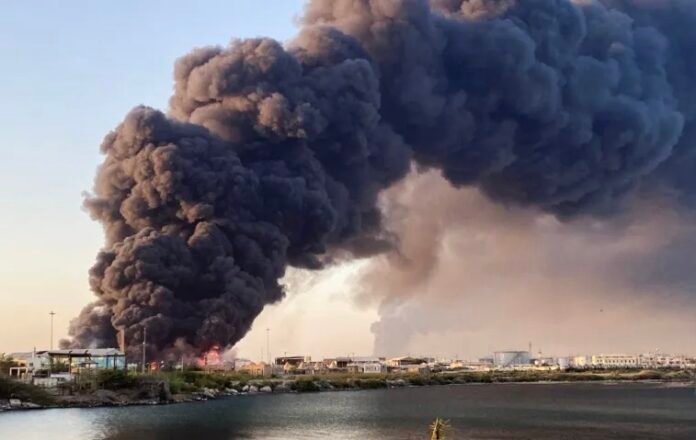
The head of the World Health Organization (WHO), Dr Tedros Adhanom Ghebreyesus, has condemned what he described as a “senseless” and devastating attack on a hospital and a kindergarten in the Sudanese town of Kalogi, an incident that has highlighted the growing dangers faced by civilians in the country’s deepening civil war.
According to information from the WHO’s monitoring system on attacks on healthcare, at least 114 people were killed in the strike, including 63 children, while 35 others were injured. The attack, which reportedly involved drones, took place on Thursday in Kalogi, a town located in South Kordofan — one of the regions increasingly caught in the crossfire between Sudan’s army and the paramilitary Rapid Support Forces (RSF).
Both the Sudanese army and the Sudan Doctors’ Network accused the RSF of carrying out the assault. The paramilitary group has not issued an official response to the allegations. In the past, the RSF has denied deliberately targeting civilians, though it has faced repeated accusations from international bodies and humanitarian organisations over alleged abuses during the conflict.
Local authorities in Kalogi offered a troubling account of how events unfolded. Essam al-Din al-Sayed, head of the town’s administrative unit, said that the area was struck multiple times. He claimed that the first drone hit a kindergarten, followed by a second strike on a nearby hospital, with a third attack occurring as people tried to help the wounded. These accounts have fueled outrage among humanitarian groups, who say the repeated targeting of civilian sites represents a serious violation of international law.
Dr Tedros said survivors of the attack had been transferred to Abu Jebaiha Hospital, also in South Kordofan, where medical teams were struggling to cope with the influx of injured people. He added that there is an urgent need for blood donations, medical supplies and additional support to handle the crisis. In a public message, he expressed concern that even emergency responders and paramedics came under threat while carrying out rescue operations.
“WHO deplores these attacks on civilians and health facilities,” he said, repeating calls for protection of medical personnel and unrestricted humanitarian access. In a separate post on social media, he urged an immediate end to the conflict, saying the Sudanese people had “suffered far too much.”
Sudan has been in turmoil since April 2023, when a power struggle erupted between the armed forces, led by General Abdel Fattah al-Burhan, and the Rapid Support Forces, commanded by General Mohamed Hamdan Dagalo, also known as Hemedti. What began as a political and military dispute quickly escalated into a nationwide war, tearing apart cities, displacing millions and plunging the country into a humanitarian catastrophe.
The Kordofan region — made up of North, South and West Kordofan — has become increasingly important in the conflict. It lies between the capital, Khartoum, and the western Darfur region, which is largely under RSF control. As the army pushes further westward in an attempt to regain lost territory, heavy fighting has intensified across Kordofan, putting nearly eight million residents at greater risk.
In a separate development, the RSF announced that it had taken control of Heglig, Sudan’s largest oil field, which lies close to the border with South Sudan. The group described the capture as a “pivotal” moment in the conflict. However, an army source told reporters that government forces had withdrawn from the area, not because of defeat, but to protect key oil infrastructure from damage.
Another source familiar with operations at the oil field said that both soldiers and oil workers had crossed into South Sudan for safety. Heglig is of immense strategic importance because it contains the main processing facilities for oil produced in South Sudan. That oil represents a major source of revenue for the southern nation and also contributes significantly to Sudan’s foreign currency earnings.
The seizure of the oil field raises new fears about the regional impact of Sudan’s war. Any disruption to production or export could worsen the economic crises faced by both Sudan and South Sudan, while also affecting energy markets in neighbouring countries.
International and regional organisations have continued to call for an immediate ceasefire, but so far, diplomatic efforts have failed to bring both sides to the negotiating table in a meaningful way. Meanwhile, civilian populations remain trapped, facing shortages of food, healthcare, clean water and basic security.
Source:Africa Publicity