
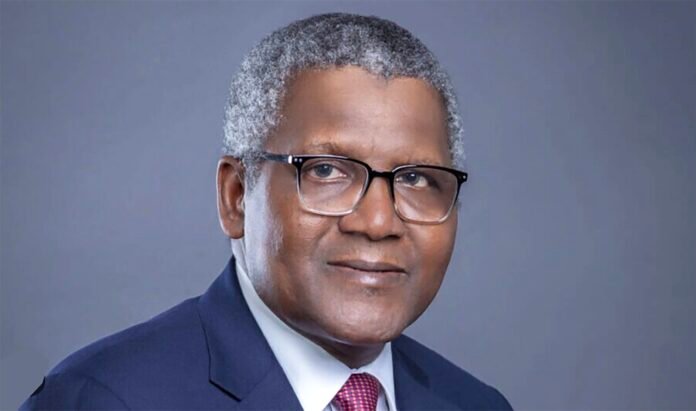
Africa’s richest businessman and Chairman of the Dangote Group, Alhaji Aliko Dangote, has renewed calls for Nigeria to significantly expand local production and strengthen backward integration, arguing that these steps are essential if the country is to emerge as Africa’s leading manufacturing and services hub.
Dangote made the remarks during a fireside chat at the Lagos Business School (LBS) Breakfast Club, where business leaders and policy experts gathered to examine Nigeria’s economic prospects and industrial future.
Push for Local Production
Dangote stressed that heavy reliance on imported raw materials and finished goods continues to weaken Nigeria’s industrial competitiveness.
“If Nigeria is serious about becoming a manufacturing hub, we must produce more locally and reduce our dependence on imports,” he said. “Backward integration is not optional; it is the foundation of any globally competitive industry.”
He noted that developing local supply chains would help stabilise costs, conserve foreign exchange, create jobs and improve long-term sustainability for manufacturers.
AfCFTA Opportunities and Risks
Dangote also pointed to the African Continental Free Trade Area (AfCFTA) as a major opportunity for Nigerian companies, while warning that access to a larger market alone would not guarantee success.
“AfCFTA opens the door to a vast continental market, but only efficient and cost-competitive businesses will benefit,” he said, adding that Nigerian firms must raise productivity to compete with peers across Africa.
n Nigeria’s 2026 Economic Outlook by Bismarck Rewane, Managing Director of Financial Derivatives Company. Rewane analysed key macroeconomic indicators, including inflation, exchange rates and fiscal policy, and linked them to long-term growth prospects.
“Nigeria’s industrial expansion will depend on macroeconomic stability and policies that encourage productivity, investment and private-sector confidence,” Rewane said.
Focus on Innovation and Skills
An interactive question-and-answer session addressed issues such as supply chain resilience, infrastructure gaps and private-sector-led growth. Participants repeatedly emphasised the need for better coordination between government policy, infrastructure development and investment.
Professor Ajai highlighted the role of innovation and human capital, saying:
“Technology, innovation and skills development will determine whether Nigeria can lead Africa’s manufacturing and services sectors.”
Event Context
According to local media reports, the event was held under the theme “Challenges and Opportunities for Making Nigeria the Leading Manufacturing and Services Hub in Africa.” Organisers said the Breakfast Club aims to foster informed dialogue on Nigeria’s economic future while supporting the development of responsible business leaders.
The programme was supported by First Bank of Nigeria, Optimus Bank, Cowry Asset Management Limited and Afrinvest Limited, partners the organisers described as committed to advancing executive education and strengthening Africa’s business environment.
Source: Africa Publicity