

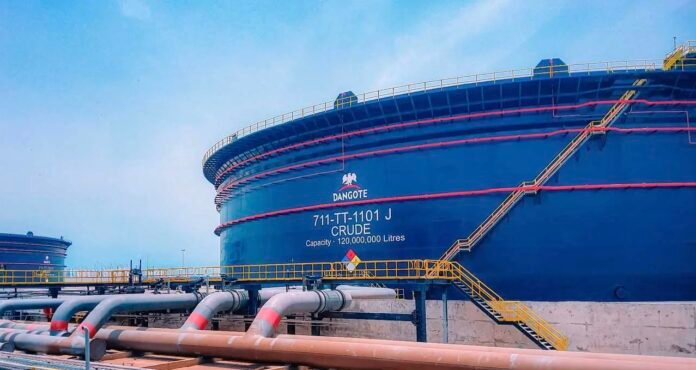
West Africa’s fuel supply landscape is undergoing a major transformation, driven primarily by Nigeria’s 650,000 barrels-per-day Dangote Petroleum Refinery and parallel efforts by governments across the region to reduce dependence on imported refined products, according to a new report by Argus Media.
The report describes the Dangote refinery as a turning point for the sub-region, noting that its operations have significantly altered long-standing fuel trade patterns by lowering import needs and increasing the availability of locally refined products for export.
Sharp Decline in Fuel Imports
Since petrol production began at the Dangote facility in September 2024, Nigeria—previously the largest gasoline importer in West Africa—has recorded a dramatic reduction in fuel imports.
Data from shipping analytics firm Kpler, cited by Argus, show that Nigeria’s net petrol imports fell to just 40,000 barrels per day in September, down sharply from 332,000 barrels per day during the same period a year earlier. This represents the lowest level on record and highlights the refinery’s growing role in meeting domestic demand.
Nigeria Becomes Regional Supplier
Beyond satisfying local consumption, Nigeria has strengthened its position as a key supplier of refined products to neighbouring countries. The report noted that net middle distillate exports, which include diesel and jet fuel, climbed to a record 145,000 barrels per day in July, compared with 82,000 barrels per day earlier in the year.
Argus added that Nigeria has largely remained a net exporter of middle distillates since May 2024, marking a significant shift for a country that had long depended on imports due to limited local refining capacity.
Regional Impact Across West Africa
The increased output from Dangote has had ripple effects across West Africa. According to the report:
• Petrol imports into the region—from Mauritania to Angola—fell by 25% year-to-date, averaging 337,000 barrels per day.
• Jet fuel imports dropped to 4,000 barrels per day, the lowest level since Kpler began tracking the data in 2016.
• Diesel imports declined to a five-year low of 162,000 barrels per day.
Argus said these trends underscore how Dangote’s operations are reducing the region’s reliance on European fuel traders and long-haul imports.
Contrast With State-Owned Refineries
While Dangote’s refinery has operated steadily despite periodic maintenance, the report contrasted its performance with Nigeria’s government-owned refineries, which continue to face operational setbacks.
The Port Harcourt refinery, with a total capacity of 210,000 barrels per day, restarted a 60,000 barrels-per-day unit in late 2024 but shut down again in May 2025. Similarly, the 125,000 barrels-per-day Warri refinery resumed operations in December 2024 only to go offline the following month, highlighting persistent challenges in reviving long-dormant facilities.
Wider Regional Developments
Argus Media noted that Nigeria is not alone in expanding refining capacity:
• In Angola, the 30,000 barrels-per-day Cabinda refinery has begun operations, producing mainly diesel and jet fuel for domestic consumption and reducing middle distillate imports.
• In Ghana, authorities are working to restore production at the 45,000 barrels-per-day Tema Oil Refinery, while smaller private refineries continue to operate intermittently.
However, the report cautioned that most large-scale new refining projects across West Africa face long development timelines, making existing facilities—particularly Dangote’s—crucial to near-term supply security.
Outlook for 2026
Argus concluded that the pace of further change in 2026 will largely depend on how reliably current refineries perform. With room to capture an even larger share of Nigeria’s domestic petrol market and sustain exports, the Dangote refinery is expected to remain central to West Africa’s ambition to establish itself as a major refining and fuel trading hub.
Source: Africa Publicity