

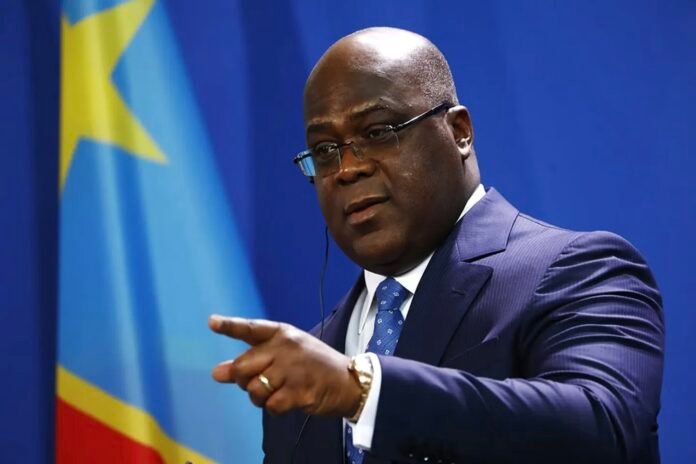
Congolese President Félix Tshisekedi accused Rwanda on Monday of violating commitments under recent peace agreements, just days after attending a ceremony in Washington, D.C., aimed at ending years of armed conflict in eastern Democratic Republic of Congo (DRC). The allegations come amid renewed fighting in the mineral-rich provinces of North and South Kivu, which have long been plagued by rebel activity and cross-border tensions.
Addressing lawmakers in Kinshasa, Tshisekedi said that Rwanda-backed M23 rebels had advanced into Congolese territory, undermining efforts to implement agreements brokered by the United States and Qatar. He did not provide specific evidence during his speech, and there was no immediate comment from the Rwandan government.
Clashes and Civilian Casualties
Over the weekend, M23 forces reportedly captured the village of Luvungi, near the border with Burundi, according to local residents who spoke to Reuters. Video footage shared by witnesses showed rebels holding a meeting in the village. Rwandan authorities have repeatedly denied any backing of the M23 rebel group.
The clashes prompted some Congolese soldiers to retreat, leading to confrontations with local defense forces, known as Wazalendo, in the nearby town of Sange. According to local officials and humanitarian sources, Sange was bombed or struck with grenades on Sunday, leaving as many as 36 people dead, including civilians. Among the deceased were reportedly two children. Civil society groups shared photos showing victims in civilian clothing, appearing to have been caught in indiscriminate attacks.
The Congolese army and M23 did not immediately respond to requests for comment, and it remains unclear which party fired the munitions responsible for the casualties. Local sources say both mortar shells and grenades were used, but no independent verification has yet been conducted.
Background: Peace Agreements and Implementation Challenges
Tshisekedi’s accusations come in the wake of multiple U.S.- and Qatar-brokered agreements aimed at stabilizing eastern Congo. In June, Congo, Rwanda, and the M23 rebel group signed a ceasefire and commitments to demobilize armed factions. Last week, Tshisekedi and Rwandan President Paul Kagame reaffirmed their commitment to the June deal and participated in new agreements in Washington, designed to reinforce peace and economic cooperation in the region.
Despite these agreements, eastern Congo remains volatile. M23, which emerged in 2012 and has received varying levels of support from external actors, has frequently clashed with Congolese forces. The region’s mineral wealth—including coltan, gold, and tin—makes it strategically important and a target for armed groups seeking both political leverage and revenue streams.
Regional Implications
The recent flare-up near Luvungi and Sange has raised concerns among neighboring countries. Burundi, Rwanda, and Uganda are all affected by cross-border instability, and analysts warn that continued attacks could trigger broader regional insecurity. Humanitarian agencies have highlighted the vulnerability of civilians, many of whom have been displaced multiple times due to ongoing conflict.
The United States and other international actors, including the African Union and United Nations, have repeatedly called for restraint and adherence to previously signed agreements. Washington has emphasized that continued violence undermines efforts to stabilize the Great Lakes region and threatens economic development and governance reforms.
Humanitarian Concerns and Next Steps
Local authorities and civil society groups have urged the Congolese government to protect civilians and investigate the weekend attacks. Humanitarian organizations are mobilizing to provide support to survivors and families of the deceased, while monitoring displacement trends in North Kivu and South Kivu.
Tshisekedi’s speech signals a potential diplomatic escalation between Kinshasa and Kigali, just weeks after high-profile peace talks in Washington. Analysts suggest that the next steps will likely involve urgent negotiations, possible deployment of neutral observers, and renewed international pressure to enforce compliance with the agreements.
Source:Africa Publicity