
KINSHASA, Democratic Republic of Congo — The Democratic Republic of Congo’s (DRC) top diplomat has appealed to the United States to strengthen sanctions on Rwanda, arguing that tougher measures are needed to uphold Washington’s credibility as a mediator in the region. The call came as Rwanda-backed M23 rebels continued a rapid advance across eastern Congo, driving hundreds of thousands of civilians from their homes and intensifying international concern over the escalating conflict.
Foreign Minister Criticizes U.S. Approach
During a late-Tuesday interview with Reuters, Congo’s Foreign Minister Thérèse Kayikwamba Wagner said the U.S. should expand its current sanctions regime to include senior Rwandan military leaders and institutions. She emphasized that without stronger accountability measures, the U.S.-brokered peace framework championed by former President Donald Trump risks losing legitimacy.
According to Wagner, new sanctions should target “individuals in the chain of command” as well as state institutions, particularly those involved in military procurement. “Condemnations are not enough,” she said. “We are seeing deaths in the thousands. Expressions of concern cannot substitute for effective action.”
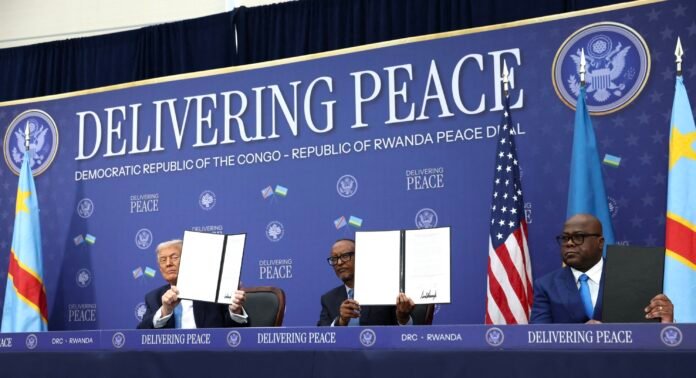
Her comments highlight deepening frustration within Kinshasa that diplomatic efforts—despite high-profile meetings in Washington last week between Presidents Félix Tshisekedi and Paul Kagame—have yet to halt one of the most severe security crises the region has seen in years.
Rwanda Pushes Back Against Sanctions Threats
Rwanda, long accused by the U.N. and the U.S. of supporting M23 rebels, maintains that its forces are only present in eastern Congo for defensive reasons. Kigali strongly rejects allegations of financing or commanding the insurgency.
In an interview on Wednesday, Rwanda’s Foreign Minister Olivier Nduhungirehe dismissed the notion that more sanctions would reduce violence. Instead, he accused the Congolese government of undermining peace efforts and violating an agreement—allegedly reached during the Washington meeting last month—to halt airstrikes in contested areas.
He argued that Congolese forces had been conducting operations “for weeks and months” before the latest escalation, claiming the government’s actions contributed to a worsening security climate. Kigali also reiterated that Kinshasa has not honored earlier commitments negotiated through U.S. and Qatari mediation.
Humanitarian Toll Mounts
The United Nations reports that approximately 200,000 civilians have fled their homes in recent days as fighting intensifies across South Kivu and North Kivu provinces. Aid officials say many of the displaced lack access to food, shelter, and medical care, raising the risk of a broader humanitarian emergency. Scores of civilians have also been killed in the violence, though accurate casualty counts remain difficult due to fluid frontline conditions.
In addition, Burundi’s Foreign Minister Edouard Bizimana told Radio France Internationale that more than 30,000 Congolese refugees had crossed into Burundi within the past three days alone. Regional officials fear that as M23 continues its advance, displacement could spill into Tanzania, Zambia, and other neighboring states.
Continued Rebel Advances Despite Peace Talks
Despite participating in Doha-based peace negotiations facilitated by Qatar, M23 has strengthened its foothold across mineral-rich eastern Congo. The group’s recent movements represent its most extensive territorial gains since its emergence over a decade ago.
On Monday, Reuters reported that M23 forces captured Luvungi, a strategic town that had served as a frontline since February. Fighting has also erupted near Sange and Kiliba, both located on the key route toward the border town of Uvira.
Rwanda’s foreign ministry issued a statement Wednesday accusing both Congolese and Burundian forces of escalating the conflict and insisted that Kinshasa was “never serious” about U.S.- and Qatar-led peace negotiations. The statement alleged that the DRC had been planning military operations for months.
International Pressure Intensifies
The United States, United Kingdom, and European Union already maintain sanctions against M23 leaders and several Rwandan officials and businesses linked to the conflict. According to diplomats familiar with the situation, Washington has prepared an additional sanctions package that could be imposed if Rwanda fails to meet its commitments to scale back its military presence—what Kigali describes as “defensive measures”—by the end of the year.
On Tuesday, the United States and nine members of the International Contact Group for the Great Lakes Region (ICG) voiced “profound concern” over renewed fighting, warning that the violence could destabilize the entire region if left unchecked.
A Tumultuous Path Forward
As the situation continues to deteriorate, Congo’s government argues that the international community must shift from expressions of concern to decisive action. Wagner reiterated that only meaningful pressure on Rwanda will reinforce Washington’s role as a credible broker in the peace process.
With M23’s advance continuing, regional tensions rising, and diplomatic efforts under strain, eastern Congo stands at a precarious crossroads—one that could shape the stability of the Great Lakes region for years to come.
Source:Africa Publicity