
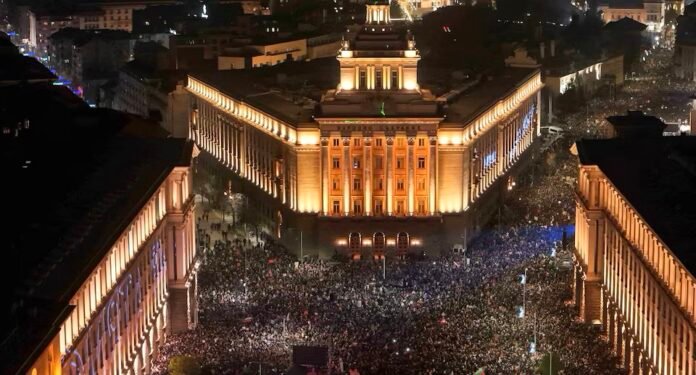
Bulgaria is experiencing yet another wave of nationwide protests, with thousands of citizens gathering across the country on Wednesday evening to demand the resignation of Prime Minister Rosen Zhelyazkov’s minority government. Demonstrators accuse the administration of failing to address long-standing corruption, economic inequality, and governance challenges in what remains the European Union’s poorest member state.
The fresh round of protests—held in Sofia and in more than 30 other towns and cities—comes at a critical moment. Bulgaria is in the final stages of preparing to adopt the euro on January 1, a major economic milestone that many citizens feel is being overshadowed by political instability and public distrust in key institutions.
Public Anger Amplifies as Protest Movement Grows
Wednesday’s demonstrations are part of a broader, months-long protest movement that has gained momentum as Bulgarians express frustration over corruption allegations, rising living costs, and lack of progress in judicial reforms. Protesters filled central Sofia, projecting illuminated messages such as “Resignation,” “Mafia Out,” and “For Fair Elections” across the façade of the National Assembly building.
Many citizens say they are exhausted by Bulgaria’s prolonged political gridlock—marked by seven national elections in just four years and deeply entrenched divisions among political parties.
“I think the energy of the people will gradually force the government to step down,” said Dobri Lakov, a 64-year-old resident of Sofia attending the protest. “Judicial reform must come first. Once the justice system functions properly, everything else will fall into place.”
Government Under Pressure as No-Confidence Vote Looms
Bulgaria’s parliament is scheduled to hold a no-confidence vote on Thursday, the sixth attempt to unseat Zhelyazkov’s government since it took office on January 15, 2024. Although previous attempts have failed, opposition parties argue that this latest vote reflects a growing loss of legitimacy.
The administration suffered a significant setback last week when it was forced to withdraw its proposed 2026 budget, the country’s first draft budget denominated in euros. The proposal had sparked widespread anger over planned increases in social security contributions and taxes on dividends—measures the government said were required to finance expanded social programs and rising state expenditures.
However, the retreat has not softened public discontent. Analysts say the budget controversy merely intensified longstanding grievances about corruption, lack of transparency, and deteriorating living conditions.
Calls for an End to “Mafia Influence”
Protesters say their demands go beyond the removal of the current government. Many are calling for deeper structural reforms that would curb the power of oligarchs, improve oversight of public funds, and restore public trust.
“It is finally time for normality to come to Bulgaria,” said Angelin Bahchevanov, an IT specialist who joined the demonstrations. “We need to free ourselves from the oligarchy, the mafia, and the forces that represent them.”
Civil society groups, professional associations, and student organizations have joined the rallies, highlighting a rare moment of unity among diverse segments of Bulgarian society.
Political Leaders Remain Divided
While pressure mounts, influential political figures remain split on whether the government should step down before euro adoption.
Former Prime Minister Boyko Borissov, leader of the ruling GERB party, stated on Wednesday—according to the Bulgarian News Agency (BTA)—that the governing coalition partners had agreed not to resign until the eurozone accession is formalized on January 1. Borissov argues that political upheaval at this stage could jeopardize Bulgaria’s entry into the common currency area.
However, opposition leaders disagree. Assen Vassilev of the reformist party We Continue the Change, one of the main organizers of the ongoing protests, insisted that the country’s eurozone entry is not dependent on the current government’s survival.
“We will enter the eurozone even if the government has resigned,” Vassilev said, calling for a complete political reset.
Looking Ahead
With the eurozone deadline approaching and public dissatisfaction intensifying, Bulgaria faces a pivotal crossroads. The outcome of Thursday’s no-confidence vote, combined with the scale of future protests, may determine whether the Zhelyazkov government can survive the mounting pressure.
For many citizens, the demonstrations represent more than a political struggle—they symbolize a long-awaited push for a transparent, accountable, and corruption-free Bulgaria as the country approaches a major economic transition.
Source:Africa Publicity