
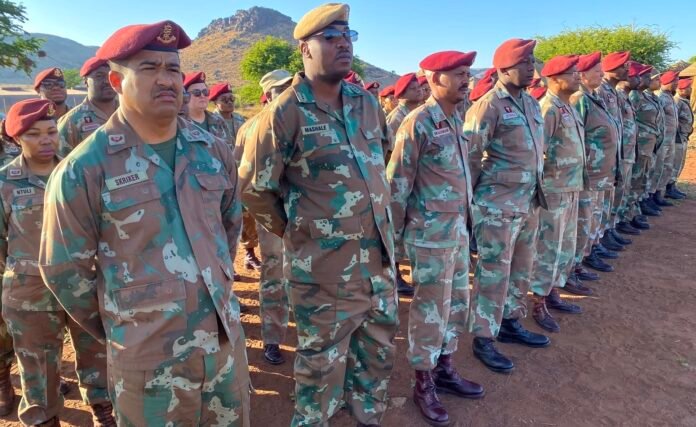
South Africa’s military is under renewed scrutiny following revelations that barely a quarter of its soldiers are considered fit for deployment, raising serious questions about the country’s ability to respond to domestic and regional security challenges. According to reports circulated on Tuesday, an internal audit of the South African National Defence Force (SANDF) found that only 27 percent of personnel meet the medical, physical and operational criteria required for active deployment.
The findings highlight the depth of the crisis confronting the SANDF, a force long regarded as one of Africa’s most capable. Analysts say the new data confirms long-standing warnings that years of budget constraints, mismanagement, and decaying logistics have hollowed out the military’s capacity.
Analyst: Years of Warnings Went Unheeded
Defence analyst Ricardo Teixeira told Eyewitness News that the readiness crisis reflects structural problems that policymakers have repeatedly failed to address.
“This is not sudden. People have been warning that the SANDF is close to collapse for a very long time,” he said. “It’s clear this is the result of chronic underfunding, poor leadership, and a culture of not taking the maintenance and strengthening of our armed forces seriously.”
He added that the SANDF’s logistical capacity—once considered one of its greatest strengths—has deteriorated to the point where large-scale deployments are increasingly difficult to sustain. Recruitment and training pipelines have also slowed, meaning the force is not replenishing experienced personnel fast enough to offset widespread retirements and attrition.
Regional Setbacks Highlight Operational Weaknesses
The audit’s findings follow a difficult year for the SANDF’s regional engagements. Late in 2023, South African troops deployed as part of the Southern African Development Community (SADC) Mission in the eastern Democratic Republic of Congo faced significant operational challenges. Units reportedly struggled to maintain supply lines, experienced equipment shortages, and operated with limited mobility, all of which hampered their effectiveness.
The deployment, intended to help stabilize the conflict-affected region, exposed gaps in manpower, readiness, and logistical infrastructure. “Those struggles were a wake-up call,” said one regional security expert who spoke anonymously. “They showed that the SANDF is no longer the robust, highly mobile force it was a decade or two ago.”
Budget Constraints Deepen the Crisis
For years, defence officials have argued that stagnant budgets have made it impossible to maintain the SANDF at the levels required for its mandate. Defence spending as a share of South Africa’s national budget has declined steadily, while police funding has grown, reflecting the government’s focus on internal law-and-order priorities rather than military operations.
Even so, Teixeira cautioned that simply increasing funding will not automatically solve the crisis. “Even doubling the budget won’t fix this without leadership and a long-term strategy,” he said. “We need a minister who truly understands the challenges, who’s prepared to overhaul systems and guide the SANDF through a complete rebuild.”
A Once-Strong Force Now Under Pressure
The SANDF, established after South Africa’s 1994 democratic transition, inherited advanced equipment, well-trained officers, and a strong support structure. For many years, it was considered one of the continent’s most capable armies, frequently contributing to peacekeeping operations across Africa.
But experts say decades of ageing equipment, skills losses, and uneven political support have eroded that reputation. Much of the air force fleet is grounded, naval vessels are under-maintained, and key army units lack modern equipment. At the same time, the SANDF continues to face expanding responsibilities, from border security to regional peace missions.
Growing Questions Over National and Regional Obligations
The revelation that less than a third of soldiers are deployable raises questions about South Africa’s ability to fulfill obligations to the African Union and SADC, as well as maintain effective security at home. The country faces frequent domestic crises—including natural disasters, civil unrest, and infrastructure sabotage—where military support has been essential.
With the SANDF now reportedly operating at a fraction of its intended capacity, officials and analysts warn that the force may struggle to meet future demands unless urgent reforms are implemented.
A Call for Urgent Intervention
Defence experts say the audit should serve as a turning point for government decision-makers. The SANDF, they argue, needs a clear strategy, stronger leadership, and a rebuild of logistics, training and maintenance systems.
“South Africa has depended on a reputation built decades ago,” Teixeira said. “The reality is that the system is deteriorating, and without action, the country risks losing the ability to protect itself and contribute meaningfully to regional stability.”
Source:Africa Publicity