

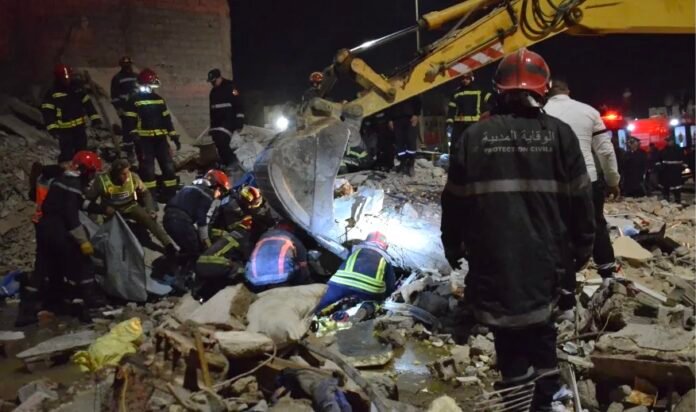
A late-night building disaster in the Moroccan city of Fez has left at least 22 people dead, including several children, and injured many others, according to local officials. The tragedy has intensified public scrutiny over aging infrastructure in one of the country’s most historically significant urban centers.
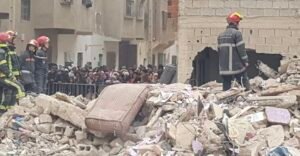
Two Multi-Storey Residential Blocks Collapse Without Warning
The incident occurred on Tuesday night in the Al-Mustaqbal neighborhood, a densely inhabited district on the western side of Fez. Local authorities confirmed that two adjacent four-storey residential buildings suddenly crumbled shortly after 10 p.m., sending residents running into the streets as clouds of dust and debris swept through the area.
The structures were home to eight families, many of whom were inside at the time of the collapse. Neighbors reported hearing loud cracking sounds moments before the buildings gave way.
Emergency responders, including police, civil defense teams, and rescue dogs, arrived quickly but faced significant challenges accessing all parts of the rubble. Heavy machinery was brought in as crews worked through the night searching for survivors and retrieving victims.
“Some nineteen people have perished in the rubble, with around twenty badly injured,” an emergency services spokesman said early Wednesday, noting that the death toll later rose to at least 22. “Four children are among those who lost their lives. The wounded have been transported to Fez University Hospital for treatment,” he added.
Survivors Describe Terrifying Moments
Residents who escaped the collapse shared emotional accounts of their experiences. One man told local television reporters that he had lost nearly his entire family.
“I lost my wife and three children,” he said. “They recovered one body, and I am still waiting for information about the others.” His voice broke as he explained that his family had been preparing for bed when the building started to shake.
An elderly woman who lived on a lower floor said her son alerted her only moments before the walls began to crumble. “He shouted that the building was coming down. We ran outside, and as soon as we did, the collapse began,” she recalled.
Witnesses told Moroccan media outlets that cracks had been visible on parts of the buildings in recent months, raising concerns that the structures may have been deteriorating for some time. However, officials have not confirmed whether prior damage played a role.
Authorities Launch Investigation Into Cause
Investigators from the regional governor’s office and national agencies have opened a formal inquiry into the cause of the collapse. Engineers are expected to examine construction records, building materials, past maintenance, and environmental conditions.
The Ministry of the Interior has not yet issued a formal statement, but local authorities say they are coordinating with national experts to assess other buildings in the area for potential risks.
Part of a Larger Pattern of Structural Failures
Building collapses are not new to Fez or Morocco more broadly. The city experienced a similar tragedy in February 2024, when five people died after a building gave way. Other incidents in previous years—including fatal collapses in 2016—have triggered periodic calls for stronger construction oversight.
In January, Moroccan housing secretary of state Adib Ben Ibrahim announced that more than 38,800 buildings across the country had been classified as being at risk of collapse. Around Marrakesh alone, over 12,000 structures were identified as vulnerable.
Morocco has also been recovering from a series of broader national disasters. In 2023, the country was struck by its deadliest earthquake in more than half a century, killing nearly 3,000 people and destroying towns and villages across the Atlas Mountains.
Public Pressure Mounts Over Housing Safety
The recent collapse comes during a period of heightened public frustration over housing conditions. Earlier this year, several Moroccan cities witnessed youth-led protests demanding improved infrastructure and services. Demonstrations escalated into unrest in some regions, leading to clashes with police, arrests, and multiple casualties.
Advocacy groups have argued that rapid urban development, combined with poverty and insufficient regulatory enforcement, has left many neighborhoods vulnerable to structural failures.
Fez Prepares for Major International Events
Fez—known for its ancient medina, UNESCO heritage sites, and strong tourism industry—is also slated to host matches during upcoming international football tournaments, including the 2030 FIFA World Cup and the African Cup of Nations. The tragedy has renewed debate over whether the city’s infrastructure can safely support both residents and the expected influx of visitors.
As rescue operations continue and families mourn the victims, officials say their immediate focus is on supporting survivors and ensuring no additional buildings in the vicinity pose imminent danger.
Source:Africa Publicity