

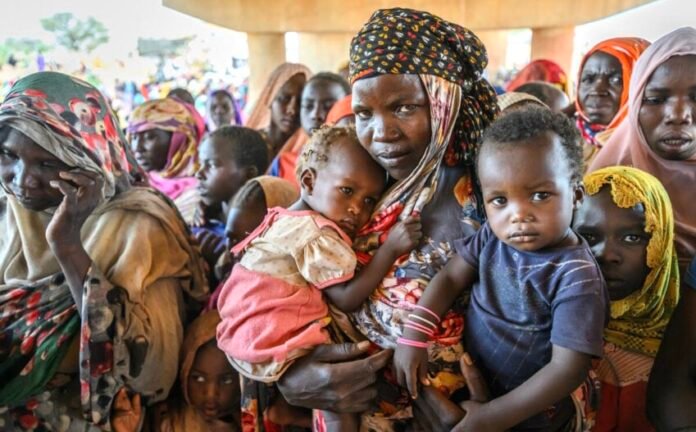
Along the dusty border between Sudan and Chad, a growing humanitarian crisis is unfolding largely out of the international spotlight. In the frontier town of Tine, Sudanese families who have escaped weeks and months of violence are discovering that safety does not automatically come with food, shelter, or medical care. With humanitarian funding falling short and relief supplies stretched thin, many newly arrived refugees are surviving only because other refugees are stepping in to help them.
Najwa Isa Adam, 32, stands among a small crowd of displaced families in a rough transit area near the border. Carefully, she serves bowls of pasta mixed with small portions of meat to a group of orphaned children who fled from al-Fashir, a city in Sudan’s Darfur region that has recently been seized by paramilitary forces following intense fighting. The children gather around her with quiet urgency, some clutching tin cups or chipped bowls, others using their hands.
Adam is also a refugee. She arrived in Tine in October after fleeing the same town. Her journey was marked by fear and danger, and she says she endured serious abuse during her escape before being rescued by a passerby. Today, she tries to push her own suffering aside to focus on helping those who are arriving after her.
“People here don’t have anything to eat,” she said quietly. “The only support we get is from the people of Tine and from other Sudanese who arrived before us.”
That support mostly comes from fellow refugees who settled in eastern Chad during earlier waves of conflict in Sudan. Some of them live in modest homes in Tine, having spent years building small lives after fleeing previous attacks in Darfur. Now, they pool what little money they have to buy sacks of rice, flour, cooking oil, and dried goods for the new arrivals. Small community cooking groups have formed near the makeshift transit camps, becoming lifelines in the absence of consistent international aid.
The lack of support is not due to a lack of need. According to the United Nations High Commissioner for Refugees (UNHCR), the agency has secured only 38% of the estimated $246 million needed to properly respond to the Sudanese refugee emergency in Chad. This severe funding gap has dramatically limited what aid groups can provide at overcrowded border points like Tine.
A significant reason for the shortage is a sharp drop in foreign funding, particularly from the United States. In 2024, the U.S. contributed approximately $68.4 million to UNHCR operations linked to Sudan and Chad, which accounted for about 32% of the agency’s total budget for the crisis. This year, that figure has fallen to $35.6 million, representing only about 10% of the growing overall budget required to address rising humanitarian needs. Attempts to reach officials at the U.S. Department of State and the U.S. Mission to the United Nations for comment went unanswered.
Under normal circumstances, refugees arriving at a border transit camp would stay only briefly before being transported to more stable, better-equipped sites further inland. These longer-term camps are intended to provide access to clean water, sanitation, education for children, healthcare facilities, and organized shelter. However, the funding shortfall has prevented adequate preparation of those sites, delaying relocation efforts and trapping families for weeks in harsh, exposed conditions near the border.
“They give people plastic sheets, just to create some shade from the sun,” explained Magatte Guisse, UNHCR’s representative for Chad. “There are no proper shelters, no tents, no long-term structures we can provide right now to the new arrivals.”
As a result, many families are sleeping outdoors, using tree branches, scraps of fabric, and worn clothes to protect themselves from the scorching daytime heat and the sudden cold that arrives after sunset. Children can be seen curled up on the rocky ground beside their parents, while elderly relatives sit on thin mats, struggling with exhaustion and dehydration.
Among them is 38-year-old Noura Mohamed Yahya, who is nine months pregnant. She fled North Darfur three months ago after repeated drone attacks made it impossible for her family to stay. She eventually crossed into Chad in early November with her children. Now, she sits beneath a tree just outside the camp’s perimeter, trying to conserve her strength as she waits for the birth of her baby.
She has no clear plan for the delivery and no access to consistent medical support. “What can I do?” she asked. “I have nothing to eat, nothing to cover my body, and nowhere safe to go.”
Local health workers warn that pregnant women, young children, and older people are at extreme risk if conditions do not improve. Malnutrition, dehydration, and untreated infections are already being reported among new arrivals. Without an urgent increase in resources, the situation could grow even more dire in the coming weeks.
The crisis at the Chad-Sudan border is part of a much larger displacement emergency caused by Sudan’s ongoing conflict. Millions of people have been forced from their homes across the country, and hundreds of thousands have crossed into neighboring nations such as Chad, South Sudan, Egypt, and Ethiopia. Chad alone hosts thousands of Sudanese refugees, placing immense strain on local communities that are themselves struggling with poverty and limited infrastructure.
Despite the difficult circumstances, there are signs of resilience. Refugees in Tine are organizing informal schools for children, sharing food in communal kitchens, and taking turns caring for the sick and the elderly. These small acts of solidarity have become one of the few sources of hope.
For Adam and others like her, helping is a way to reclaim dignity in a situation where so much has been taken away. “We’ve all lost something,” she said. “But here, at least, we share what we have.”
As international organizations continue to sound the alarm, the people along the Chad-Sudan border wait, uncertain if more help will come. Until then, refugees will continue feeding refugees — a powerful reminder of human resilience in the face of neglect and crisis.
Source:Africa Publicity