
Emmanuel Mihiingo Kaija
Africa in 2025 exists in what historians and political scientists describe as the long present, a historical compression in which legacies of colonial extraction, post-independence governance failures, and global geopolitical neglect intersect with contemporary crises of climate, health, and demography. The continent is home to over 1.4 billion people, more than 60% under the age of twenty-five, yet millions live in acute precarity. Today’s crises are not isolated incidents but the materialization of structural neglect: armed conflicts are sustained not only by local grievances but by global economic incentives; climate shocks have moved from seasonal inconvenience to existential threat; and democratic institutions falter under a combination of corruption, coups, and the quiet normalizing of authoritarianism. This is a continent where growth statistics of 4–4.5% coexist with 460 million people living below the international poverty line, and where the vibrancy of youth populations is matched by alarming levels of unemployment and social disillusionment. To understand Africa today is to recognize that its crises are not accidental—they are deeply intertwined, requiring holistic analysis rather than fragmented reportage or reductive narrative.
Sudan and the Meaning of State Collapse in the 21st Century
Sudan’s conflict, now entering its third year, exemplifies a form of modern warfare that targets the very conditions of life rather than opposing armies alone. The confrontation between the Sudanese Armed Forces and the Rapid Support Forces has displaced 12–14 million people, nearly one-third of the population, while over 20 million face acute food insecurity, including famine conditions in Darfur and Kordofan. Hospitals, universities, water treatment plants, and transportation networks have been deliberately destroyed or militarized, leaving civilians to navigate an almost complete breakdown of public infrastructure. Women and children constitute the majority of the displaced, facing systematic sexual violence, forced recruitment, and survival-based exploitation. Beyond the immediate humanitarian cost, Sudan’s collapse reveals a global ethical failure: the international system has largely maintained a posture of detachment, fragmented sanctions, and selective diplomatic engagement. Regional powers have leveraged the chaos for strategic advantage, while global attention remains diffused, allowing armed actors to operate with impunity. The Sudanese example demonstrates that in modern conflicts, civilian suffering is not collateral damage but a strategic instrument, and that the absence of accountability at both local and international levels is itself a force multiplier for crisis.
Eastern Democratic Republic of Congo and the Political Economy of Endless War
Eastern DRC remains emblematic of what scholars term a “permanent emergency,” a zone where structural violence, state fragility, and global demand for resources intersect to produce relentless civilian suffering. By 2025, over 7 million people are internally displaced, with repeated cycles of flight, return, and renewed displacement eroding social cohesion and trust. The resurgence of M23, in combination with dozens of local militias and the partial withdrawal of UN peacekeeping forces, has created a complex security vacuum in North and South Kivu, where civilians are subjected to indiscriminate attacks, forced recruitment, and sexual violence used as a tool of social control. Compounding these dynamics is the region’s mineral wealth: cobalt, coltan, gold, and tin—essential components of smartphones, electric vehicles, and renewable energy infrastructure—tie local violence directly to global technological markets. Certification schemes and corporate social responsibility initiatives have failed to break this link. Eastern Congo illustrates the brutal reality that modern globalization can thrive on human suffering, where the extraction of minerals for global progress is subsidized by local insecurity and death. Beyond immediate conflict, this situation underscores a structural paradox: the very technologies hailed as solutions for sustainable development in the Global North are simultaneously produced through the systematic destabilization of vulnerable communities in Africa.
The Horn of Africa: Climate Collapse as Structural Violence
In the Horn of Africa, climate change is no longer a theoretical future threat but a lived catastrophe with profound social, economic, and political implications. Recurrent droughts since 2020 have destroyed pastoral and agro-pastoral livelihoods across Somalia, Ethiopia, and northern Kenya, with the October–December 2025 rains among the poorest recorded in decades. Over 1.5 million people in Somalia alone have been displaced by drought, while millions more experience food insecurity, acute malnutrition, and loss of traditional livelihoods. Pastoralist communities, once resilient through centuries of knowledge-driven adaptation, now face existential threats as livestock die, grazing land diminishes, and water sources vanish. Children are particularly affected: malnutrition rates exceed 30% in several districts, with long-term consequences for physical development, cognitive function, and intergenerational poverty. Climate-induced displacement intersects with debt crises, weak governance, and inadequate humanitarian response, creating a structural trap in which communities that contribute least to global greenhouse emissions bear the highest costs. The Horn of Africa exemplifies climate injustice, demonstrating that adaptation must move beyond technical solutions to include fiscal, political, and ethical dimensions of global responsibility.
West Africa and the Sahel: Militarization, Youth Disillusionment, and the Normalization of Exception
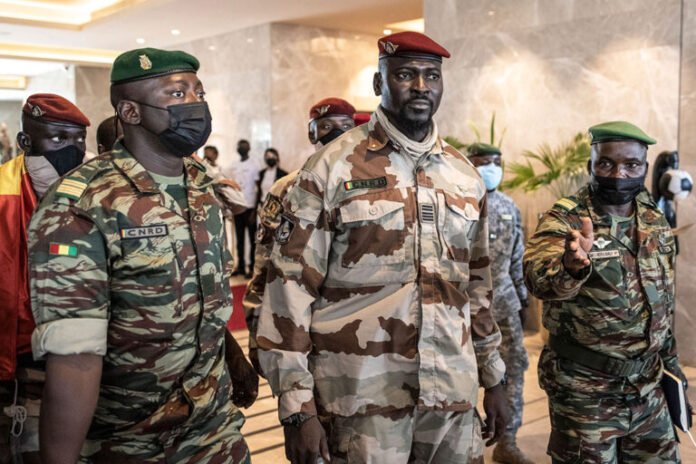
West Africa and the Sahel present a complex interplay between political instability, youth alienation, and violent extremism. Since 2020, military coups in Mali, Burkina Faso, Niger, and Guinea have disrupted constitutional norms, while renewed instability in 2025 in Guinea-Bissau and Benin has demonstrated the fragility of democratic institutions. Jihadist violence continues unabated, killing tens of thousands and displacing millions. Yet the deeper crisis lies in legitimacy: youth unemployment in the region exceeds 30–40%, fueling frustration and eroding faith in democratic institutions. Military regimes have exploited this disillusionment, consolidating authority through media control, digital surveillance, and selective repression. Regional institutions such as ECOWAS are constrained, caught between the moral imperative of upholding democratic norms and the practical imperative of protecting civilians. The Sahel has become a testing ground for a new model of authoritarianism: militarized, nationalist, digitally monitored, and selectively anti-Western, yet deeply enmeshed in global political and economic networks. This raises profound questions about the sustainability of democratic governance and the ethical responsibilities of regional and international actors.
Economic Growth Without Shelter
Sub-Saharan Africa’s macroeconomic statistics present an ambiguous narrative. While projected growth of 4–4.5% in 2025 is positive on paper, it obscures deep structural vulnerabilities. Inflation, particularly of food and energy, continues to outpace wage growth, eroding household purchasing power and increasing inequality. Debt servicing consumes a growing portion of national budgets, crowding out essential investment in health, education, and social protection. Africa bears over 25% of the global disease burden but receives less than 3% of global health expenditure, highlighting a stark mismatch between needs and resources. Education systems struggle to accommodate rapid population growth, leaving millions of youth without quality schooling. Economic growth that does not translate into social resilience is not development—it is delayed justice. Without structural reform of trade, taxation, and finance, headline GDP gains will remain largely symbolic, leaving ordinary Africans vulnerable to shocks that compound over generations.
Religion, Migration, and the Ethics of Survival
Religious institutions continue to play a central role in African societies, often functioning as de facto welfare systems, providing food, shelter, and psychosocial support in the absence of functioning state structures. At the same time, forced displacement affects over 40 million Africans in 2025, both internally and across borders. Migration routes to North Africa and Europe are increasingly militarized and lethal, reflecting a global preference for border security over human security. Religious communities, civil society organizations, and informal networks frequently fill gaps left by state failure, highlighting both the resilience of African societies and the moral imperative for global actors to support dignity over deterrence. Migration in this context is not merely a logistical or security challenge; it is a moral barometer of global responsibility and ethical governance.
Conclusion: Africa and the Crisis of Global Conscience
Africa’s present is a litmus test for global ethical responsibility. The continent’s challenges—climate insecurity, extractive economies, demographic pressures, governance failures, and conflict—cannot be understood in isolation. They are interdependent, accelerated by structural injustices and global indifference. Africa’s struggle to breathe is a warning that humanitarian crises, political instability, and environmental collapse in the continent will have ripple effects worldwide. Global actors must recognize that African futures are inseparable from global futures, and that justice delayed, accountability deferred, and resources withheld are not merely African problems—they are moral crises for the entire world.
Bibliography
African Development Bank Group. African Economic Outlook 2025. Abidjan: AfDB, 2025.
International Monetary Fund. World Economic Outlook 2025: Navigating Global Fragmentation. Washington, DC: IMF, 2025.
International Rescue Committee. Emergency Watchlist 2025. New York: IRC, 2025.
ReliefWeb / United Nations OCHA. Global Humanitarian Overview 2025. New York: United Nations, 2025.
United Nations High Commissioner for Refugees (UNHCR). Global Trends: Forced Displacement 2024/2025. Geneva: UNHCR, 2025.
World Bank. Africa’s Pulse 2025. Washington, DC: World Bank, 2025.
World Food Programme / FAO. Hunger Hotspots: Early Warnings on Acute Food Insecurity. Rome: FAO/WFP, 2025.
United Nations Development Programme (UNDP). Human Development Report 2024/2025. New York: UNDP, 2025.
Al Jazeera. “Military Coups and Sahel Instability,” December 2025.
Reuters. “Sudan: War Creates World’s Largest Displacement Crisis,” December 2025.
Reuters. “Congo Fighting Forces Civilians to Flee as Rebels Seize Key Towns,” December 2025.
Disclaimer:
The views expressed in this commentary are solely those of the author and do not in anyway reflect the opinions or editorial policy of Africa Publicity