

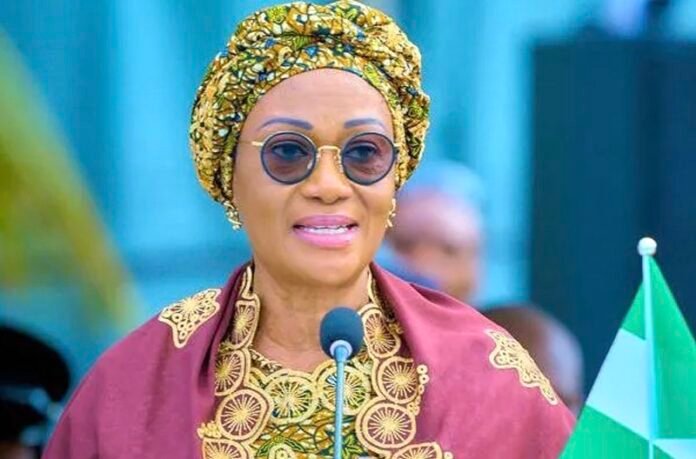
Nigeria’s First Lady, Oluremi Tinubu, has publicly endorsed recent U.S. military airstrikes targeting Islamist militants in north-west Nigeria, describing the operation as timely and beneficial while indicating that Abuja is open to deeper and sustained security cooperation with Washington.
Speaking during a week-long official visit to the United States, Tinubu said the Christmas Day airstrikes carried out in Sokoto State were welcomed by the Nigerian government amid growing insecurity linked to insurgent groups and criminal bandit networks. In comments to Fox News Digital, she characterized the intervention as a positive development and suggested Nigeria expects further collaboration of a similar nature.
According to Tinubu, Nigeria’s security challenges have reached a scale that requires stronger international partnerships. “The intervention of the U.S. was quite a welcome development,” she said, adding that Nigeria is seeking closer cooperation with the United States on counter-terrorism and internal security. “We are expecting that there will be more.”
The U.S. airstrikes, which reportedly targeted militant hideouts in remote areas of north-west Nigeria, have drawn renewed attention in Washington to the country’s long-running security crisis. The issue has also reignited debate over religious violence and human rights, subjects that have previously strained relations between both countries. During his first term, former U.S. President Donald Trump designated Nigeria a “country of particular concern” over alleged violations of religious freedom, a classification Nigerian authorities strongly disputed.
Tinubu rejected the idea that Nigeria’s violence is driven by a single religious agenda, stressing that the conflict is rooted in terrorism, organised crime and weak state presence in rural areas. She pointed to armed groups operating in forests and remote communities, where kidnappings for ransom and attacks on civilians have become frequent.
“Terrorist groups hide in the forest, and also bandits and other people are kidnapping for ransom,” she said, noting that the government’s priority remains the protection of all citizens regardless of faith or region.
She outlined several steps taken by President Bola Tinubu’s administration to address the crisis, including the declaration of a national security emergency, plans to recruit 50,000 additional police officers, and the redeployment of more than 11,000 officers previously assigned to VIP protection duties. These officers, she said, are being reassigned to areas most affected by violence.
Responding to criticism from advocacy groups, particularly over attacks on Christian communities, the First Lady said the scrutiny has opened the door for more constructive engagement between Nigeria and the United States. “We have that attention. We have the conversation going,” she said, expressing optimism that continued dialogue would improve cooperation and understanding on both sides.
During meetings with senior U.S. officials, Tinubu said she sought to explain the complexity of Nigeria’s security environment and cautioned against oversimplified narratives. “We live in Nigeria. We know the situation on the ground,” she said, emphasizing the need for policies informed by local realities.
Tinubu’s background reflects Nigeria’s religious diversity. She is an ordained Christian pastor and a former senator who served until 2023, while her husband, President Bola Tinubu, is Muslim. She also heads the Renewed Hope Initiative, a non-profit organisation aligned with the administration’s social and humanitarian programmes.
Beyond security, the First Lady linked peace and stability to Nigeria’s economic recovery. She highlighted the country’s vast reserves of critical minerals such as lithium and cobalt, which have drawn growing U.S. interest as Washington seeks to reduce reliance on China in global supply chains. Persistent insecurity in mining regions, however, remains a major obstacle to foreign investment.
“We’re doing all we can to make sure that when investors come, they can feel comfortable and their investment can yield,” she said.
Nigeria, Africa’s most populous nation with over 230 million people, has faced decades of insurgency, corruption and economic challenges. Groups such as Boko Haram and Islamic State West Africa Province, alongside criminal bandits, have contributed to widespread displacement and tens of thousands of deaths over the past decade. While casualty figures vary and are difficult to independently verify, the violence continues to place Nigeria’s security policies under intense domestic and international scrutiny.
Source: Africa Publicity