

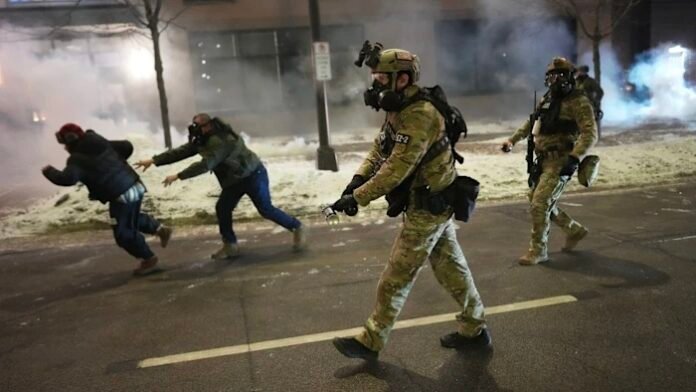
A growing number of Nigerians living in the United States are reportedly going into hiding, abandoning their jobs, or quietly returning home as fear spreads over an aggressive immigration enforcement campaign led by President Donald Trump’s administration.
Findings by Saturday PUNCH indicate that intensified operations by the US Immigration and Customs Enforcement (ICE), including house-to-house raids and mass detentions, have created widespread anxiety among immigrant communities. Many undocumented immigrants, and even those with pending cases, now limit public movement to avoid encounters with federal agents.
President Trump relaunched a hardline immigration policy immediately after his inauguration in January 2025, directing ICE to arrest and deport undocumented immigrants swiftly. While the administration maintains that the policy enforces existing immigration laws, critics argue that its implementation has been excessively harsh and has resulted in loss of lives and severe trauma.
The fear intensified following reports of deaths linked to ICE operations and detention facilities. According to available records, at least 32 people died in ICE custody in 2025, making it one of the deadliest years in over two decades. In 2026 alone, no fewer than eight deaths have been reported during interactions involving ICE officials.
Two recent fatal shootings in Minneapolis, Minnesota, have particularly shaken immigrant communities. On January 7, 37-year-old Renée Good was shot and killed by an ICE agent during an enforcement operation. The medical examiner later ruled her death a homicide caused by multiple gunshot wounds. Barely weeks later, on January 24, another 37-year-old, Alex Pretti, an intensive care nurse at the Minneapolis VA Medical Center, was also shot dead during a federal immigration operation.
These incidents, alongside reports that about 70,000 people have been detained and roughly 540,000 deported since the crackdown began, have fueled panic nationwide.
Nigerians living in the US told Saturday PUNCH that many of their compatriots have stopped reporting to work, especially in factories, shops, and service jobs. Some now rely on home-based businesses and online trading to survive, while others have chosen to leave the country quietly to avoid forced deportation.
A Nigerian woman, who asked to be identified as Senior Immigrant, described the atmosphere as traumatising. In a viral Instagram video, she tearfully lamented what she described as indiscriminate targeting of immigrants.
“It is very traumatising the way ICE is treating immigrants,” she said. “People are scared for their lives. Some don’t even go out anymore.”
Speaking further, she shared personal examples of how fear has disrupted livelihoods. She said her shop assistant stopped coming to work after ICE raids were reported in nearby areas of New Jersey.
“People are staying indoors. Families that worked in factories have stopped. Some now sell food or goods from their homes through online orders,” she explained, adding that community members now contribute money to support affected families.
Corroborating her account, the President of the Nigerian Community in Maryland, Mrs Chris Ademiluyi, confirmed that many Nigerians had gone underground rather than immediately returning home.
“People are hiding because Nigeria is not any better economically or security-wise,” she said, noting that most affected individuals are reluctant to speak publicly due to fear.
The issue has also sparked debate within religious and social circles. The Lead Pastor of Lighthouse/Rejuvenation Church in Rosenberg, Texas, Pastor Shola Adeoye, warned on Facebook that fear-driven decisions could worsen trauma.
“Some Nigerians are moving back home due to fear of this administration. It’s not wise to bury yourself before death,” he wrote, generating mixed reactions online.
Meanwhile, immigrant advocacy groups say the crisis is compounded by policy restrictions. The Executive Director of the Washington DC–based Nigerian Center, Mr Gbenga Ogunjimi, said Nigerians were facing layered challenges, including visa restrictions and reduced access to immigration benefits.
He explained that a partial visa ban imposed in December 2025 had affected Nigerians’ ability to apply for visas, work authorisation, asylum, permanent residency, and even citizenship.
“The ban has denied people opportunities they were already in the process of pursuing,” Ogunjimi said, adding that his organisation now receives an influx of Nigerians seeking guidance.
According to him, some immigrants are considering self-deportation, while others are weighing legal options to remain in the US. However, he noted that there is no clear data on how many Nigerians have already returned home.
As the crackdown continues, uncertainty remains high. For many Nigerians in the US, daily life has become a careful balance between survival, fear, and difficult choices about whether to stay, hide, or leave altogether.
Source: Africa Publicity