

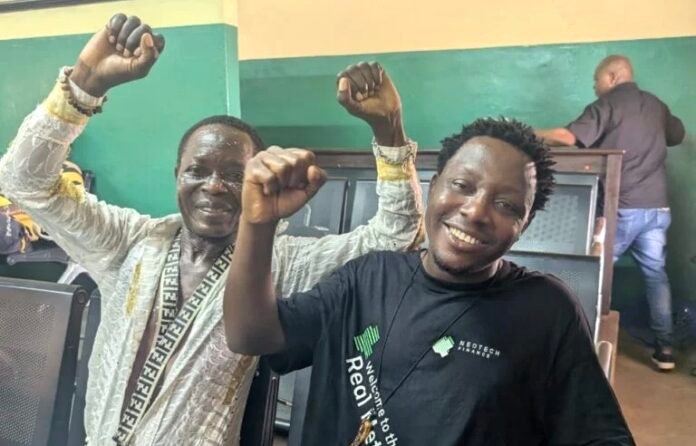
Two civil rights activists have been formally charged before a Lagos magistrate’s court following their involvement in a demonstration opposing alleged unlawful demolitions and forced evictions in the state. The case, which has drawn public attention due to the personalities involved and a legal argument over courtroom representation, was heard at the Yaba Chief Magistrate’s Court on Thursday.
The defendants — Comrade Hassan Taiwo, widely known by the nickname “Soweto,” and fellow activist Dele Frank — were brought before the court by the Lagos State Police Command. Authorities allege that the pair played leading roles in a protest staged near the Lagos State House of Assembly, where demonstrators voiced opposition to what they described as illegal demolitions, land seizures, and the displacement of residents.
Charges Filed by Police
According to the prosecution, the activists are facing a five-count charge. The allegations include conspiracy, unlawful assembly, obstruction of traffic, behaviour likely to disturb public peace, issuing threats, and chanting songs considered abusive toward law-enforcement officials and the Lagos State Government. Prosecutor Anthony Ihiehie informed the court that the offences were said to have occurred on January 28, 2026, around Allen Avenue in Alausa and within the vicinity of the State House of Assembly complex.
The prosecution argued that the accused individuals acted in concert and engaged in conduct that could incite disorder, disrupt normal movement of vehicles, and create tension among members of the public. Law-enforcement authorities maintain that public demonstrations must comply with established regulations to prevent security risks and traffic gridlock in heavily populated urban areas such as Lagos.
Defendants Deny Allegations
Both Taiwo and Frank entered pleas of not guilty to all counts read before the court. Their legal team indicated that the protest was peaceful and aimed at drawing attention to social and housing concerns affecting vulnerable communities. Supporters of the activists view the case as part of a broader debate about citizens’ rights to assemble and speak out on governance issues, especially those linked to housing and urban development policies.
Courtroom Disagreement Over Counsel Appearance
Proceedings took an unexpected turn when prominent human rights lawyer Femi Falana, a Senior Advocate of Nigeria (SAN), announced that he would represent the defendants. The prosecutor raised an objection, referencing a 2025 court decision from Oyo State which he claimed limited the appearance of Senior Advocates in lower courts. This objection introduced a legal debate regarding professional hierarchy and courtroom jurisdiction.
Falana contested the claim, arguing that neither the Nigerian Constitution nor the Lagos State Magistrates’ Court Law prohibits Senior Advocates from representing clients in magistrates’ courts. He maintained that all qualified legal practitioners, regardless of rank or title, possess the right to appear before such courts when engaged by a client.
Magistrate’s Ruling and Bail Conditions
Chief Magistrate I.O. Alaka dismissed the objection, ruling that the professional title of Senior Advocate does not restrict where a lawyer may practice. The magistrate emphasized that legal representation should not be curtailed by rank, thereby allowing Falana to continue as counsel for the defendants.
Following the ruling, the court granted bail to both accused persons. Each defendant was ordered to post bail set at ₦200,000, with two sureties required as part of the conditions. The matter was subsequently adjourned to March 3, 2026, for mention, meaning the court will reconvene to review the status of the case and determine the next procedural steps.
Broader Public Interest
The case highlights ongoing tensions surrounding urban development, housing rights, and public demonstrations in Lagos, a city that frequently experiences disputes over land use and redevelopment projects. While authorities stress the need for order and compliance with public-safety regulations, civil society groups continue to advocate for the protection of protest rights and due process for displaced residents. As the legal proceedings continue, the trial is expected to remain under close public and media observation.
Source: Africa Publicity