

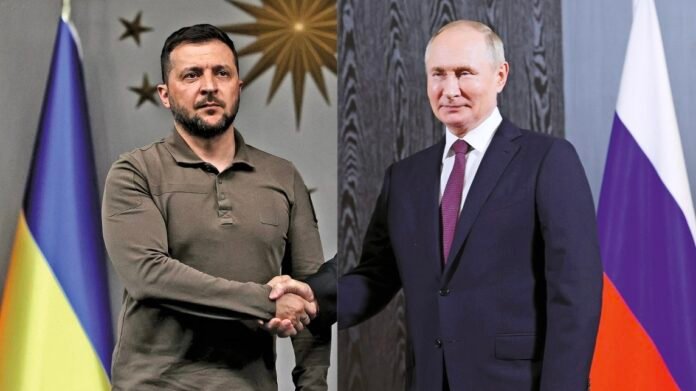
Russia has indicated that it is prepared to receive Ukrainian President Volodymyr Zelensky in Moscow for face-to-face negotiations with President Vladimir Putin, with senior Kremlin officials stating that security guarantees would be provided if such a visit were agreed upon. The remarks come amid renewed international efforts to advance peace discussions and explore the conditions for a potential ceasefire in the ongoing conflict between the two countries.
Yuri Ushakov, a senior foreign policy aide to President Putin, said the possibility of a direct meeting between the two leaders is not a new concept for the Kremlin. According to him, Moscow has repeatedly expressed openness to this format of dialogue, emphasizing that any engagement would need to be carefully prepared and structured to produce “concrete and positive outcomes.” Ushakov added that Putin has previously told journalists that Russia would ensure Zelensky’s personal safety and provide appropriate working conditions should talks be held in the Russian capital.
His comments were made public through Russian state media channels, reflecting Moscow’s continued effort to present itself as willing to engage in high-level diplomacy. Ushakov also claimed that the topic of a Putin–Zelensky meeting had surfaced multiple times during telephone discussions with U.S. President Donald Trump, suggesting that Washington has remained involved in encouraging direct communication between the two sides.
On the Ukrainian side, Foreign Minister Andrii Sybiha recently reiterated that President Zelensky is prepared to meet Putin in person if it could help resolve key sticking points in the war. In an interview with European media, Sybiha stressed that unresolved territorial disputes and the status of the Zaporizhzhia Nuclear Power Plant remain among the most sensitive issues in negotiations. He argued that direct dialogue between the two presidents could be necessary to break the current deadlock, while simultaneously accusing Russia of slowing progress toward a comprehensive settlement.
These developments follow a recent round of direct Ukraine–Russia talks held under a U.S.-supported diplomatic initiative. The meetings, which took place in Abu Dhabi, involved trilateral participation from Ukraine, Russia, and the United States and were conducted largely behind closed doors. Officials from all sides described the discussions as difficult but not without value. Ukrainian representatives labeled the atmosphere “constructive,” whereas Kremlin spokesperson Dmitry Peskov cautioned that substantial disagreements remain and that relations are far from cordial at this stage.
Negotiators reportedly devoted significant time to discussing the framework of a potential ceasefire, including monitoring and verification mechanisms that could be implemented if hostilities were paused. Ukrainian officials noted that the composition of the Russian delegation differed from earlier negotiation rounds and described the tone as more focused, with fewer ideological or historical digressions than in previous meetings.
International reactions to the renewed diplomatic push have been mixed but generally attentive. President Trump publicly offered an optimistic assessment, telling reporters that positive developments were emerging in relations between Kyiv and Moscow. European leaders, meanwhile, have expressed cautious support while urging that any summit be held under conditions perceived as neutral and secure for both parties.
The question of location has remained a point of contention. Reports indicate that Putin previously floated Moscow as a potential venue during a late-summer phone conversation with Trump in 2025, an idea Zelensky was said to have declined at the time. French President Emmanuel Macron later suggested that a neutral country such as Switzerland—particularly Geneva—might serve as a more acceptable setting for both delegations.
Switzerland’s involvement carries legal and political complexities due to the International Criminal Court’s 2023 arrest warrant for Putin related to the unlawful deportation and transfer of Ukrainian children, which the ICC classifies as a war crime. Swiss officials have nonetheless stated that the country would be willing to host talks and have indicated that temporary immunity arrangements could theoretically be considered if the visit were strictly for peace negotiations. Russian authorities have not formally accepted such proposals.
German Chancellor Friedrich Merz also weighed in, noting in media interviews that there had been discussions about arranging a meeting within a short timeframe, though he voiced doubts about whether both leaders would ultimately agree to attend. Despite periodic speculation and multiple diplomatic initiatives, Putin and Zelensky have not met in person since 2019, underscoring the persistent challenges facing efforts to achieve a negotiated resolution to the conflict.
Source: Africa Publicity