

By Emmanuel Mihiingo Kaija
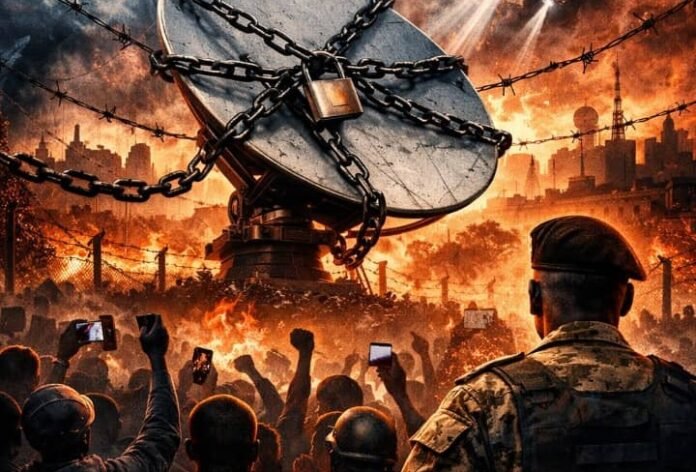
There comes a point in the life of a nation when a piece of paper is less a bureaucratic memo than a political manifesto by implication — a quiet declaration of how far power is willing to push before visibility collapses into control. In late December 2025, less than three weeks before Uganda’s January 15, 2026 general election, such a watershed moment unfolded. On December 19, 2025, the Uganda Revenue Authority (URA) issued a memorandum that effectively halted the importation of Starlink satellite internet equipment and related communication devices, unless the importer produced formal written clearance from the Chief of Defence Forces, General Muhoozi Kainerugaba, who is not only the head of the Uganda People’s Defence Forces (UPDF) but also the son of President Yoweri Museveni. This is not an arcane regulatory nuance; this is power transposed into technical obstruction with political intent. Citizens seeking a lifeline to uncensored connectivity now require the signature of the military chief — a move with profound implications for digital rights, civic participation, and electoral transparency.
Starlink, the satellite internet constellation owned by Elon Musk’s SpaceX, operates independently of traditional terrestrial networks — meaning it can deliver broadband connectivity even when fibre optics, cell towers, or local infrastructure are restricted or monitored. Although Starlink is not yet officially licensed to operate in Uganda, a growing number of Ugandans had been bringing in the hardware through private importation to circumvent limitations with land‑based internet, especially in remote districts where connectivity has long lagged behind urban centres. Before this restriction, dozens of users in regions such as Karamoja, West Nile, Rwenzori, and parts of Busoga regularly discussed the potential of satellite internet as a means of accessing information and communication services in ways that local mobile data simply could not match. The URA’s directive — framed by authorities as standard control over communication tech — is widely perceived by digital rights advocates, opposition parties, and tech communities as a pre‑emptive strike on uncensorable channels of information right when they matter most.
To understand the gravity of this moment, it helps to rewind the tapes of Uganda’s recent political and digital history. In the January 2021 general election, the government ordered a complete internet shutdown. Across 13–18 January 2021, domestic internet traffic dropped precipitously — by as much as 95%, according to network observers — when telecom providers were instructed to block access to nearly all internet services, including social media platforms and messaging apps such as Facebook, WhatsApp, Twitter, and others. This blackout engulfed the crucial election period, isolating more than 10.6 million users, paralyzing mobile money services, e‑commerce, ride‑hailing apps like SafeBoda, online banking, and even digital health services.
The economic impact of that shutdown was not trivial. NetBlocks — an internet monitoring organization — estimated that such national outages can cost economies millions of dollars, both in lost productivity and halted digital commerce. In 2021 alone, the almost‑five‑day blackout was associated with an estimated $9 million in direct losses to Uganda’s digital economy and widespread hardship among ordinary users. Freelancers, micro‑entrepreneurs, students, and small businesses reliant on internet connectivity saw earnings vanish overnight — one motorcycle ride‑hail driver reportedly lost income he would have otherwise earned over several days.
More than just a technical disruption, the shutdown deeply affected civic life. According to the East African Court of Justice, the 2021 restrictions prevented citizens from communicating, receiving and disseminating opinions, monitoring electoral conduct, and accessing information critical for the democratic process. Rights groups argued it violated fundamental freedoms — including freedom of expression, assembly, information, and participation in government.
Fast forward to December 2025: Uganda’s pre‑election playbook is already taking shape. Not only is satellite internet effectively sidelined, but senior government officials — including the State Minister for ICT and National Guidance — have openly stated that if online platforms are used to “incite violence,” authorities may interrupt Internet access again during the 2026 general election. The minister even said the government and the Uganda Communications Commission (UCC) possess the “gadgets and authority to restrict access” if deemed necessary, setting the stage for another possible nationwide outage.
Seen through this historical lens, the URA’s Starlink import restriction is more than a cost‑recovery or customs measure; it is an anticipatory digital chokehold at the exact moment when unfiltered connectivity — not filtered through state networks — could empower voters, journalists, civil society, and independent observers. Starlink’s technology, by design, bypasses local network infrastructure and can serve communities regardless of government‑controlled gateways. Restricting access to it — by conditioning import clearance on military authorisation — turns what should be a technology access issue into a national security control point directly tied to the election.
Critics contend that by entangling communications infrastructure with the military’s oversight, the Ugandan state is not only fortifying its capacity to monitor and regulate public discourse, but also consolidating the information environment in ways that make transparency and real‑time reporting harder when it matters most. Opposition leader Bobi Wine, 43 — a musician turned politician who is standing again in the 2026 poll against President Museveni, now 81 and in power since 1986 — explicitly criticised the Starlink restriction on social media, accusing the government of attempting to “prevent transparency in the election process.” This is not abstract rhetoric; it echoes a broader pattern where access to information becomes entangled with political control, shaping who gets to tell the story of events as they unfold.
The social chatter reflects this broader angst. In online forums and community groups, conversations about the 2026 election increasingly revolve around fears of data blackouts, digital surveillance, and another shutdown. Many Ugandans recall with bitter clarity the crippling effects of the 2021 block — not just on politics but on their everyday lives: farmers unable to check market prices, artisans unable to promote goods, students unable to access educational materials, and families unable to send remittances. The internet, in these exchanges, is not just a convenience; it is lifeline, livelihood, and voice.
This reality gives the Starlink restriction a raw immediacy. Citizens see it not as a regulatory measure, but as strategic containment — part of a broader architecture of digital control coinciding with heightened political tension. In a world where signals carry images of rallies, arrests, ballot queues, and human stories in real time, the ability to connect anywhere and everywhere isn’t just about speed; it’s about witnessing, accountability, and collective memory. Control over that ability is control over narratives themselves.
A final note for the historically mindful: this is not happening in a vacuum. Uganda’s pattern of internet restrictions during politically sensitive periods predates 2021. Social media bans appeared in 2016, and even before then, authorities sought to control SMS transmission and online platforms in moments of civic tension. What we are witnessing in 2025 is not an isolated incident but a crescendo in a decades‑long trajectory where information spaces are contested territory in Ugandan politics.
In the end, the question is not merely whether satellite internet will arrive in millions of homes next year. The deeper question is who will be allowed to see, speak, and connect at moments that define the nation — moments that are already unfolding as Uganda marches toward its January 15, 2026 election.
Bibliography
News & Reporting
Uganda restricts imports of Starlink equipment weeks before election — Reuters, December 23, 2025.
Uganda Mandates President’s Son’s Approval for Starlink Imports — WeeTracker, December 23, 2025.
Uganda Blocks Starlink Imports Ahead of January Elections — Techweez, December 24, 2025.
Uganda Restricts Starlink Imports Ahead of Election — TechLabari, December 23, 2025.
Historical Internet Disruption & Impact
NetBlocks report on Uganda Internet shutdown 2021.
Information on Uganda’s internet shutdown and impacts — OONI Probe and InternetSociety Pulse.
East African Court of Justice and internet effects in 2021 elections.
Context & Analysis
Monitor reports on potential 2026 internet interruption by government official.
Historical pattern of internet and social media restrictions in Ugandan elections.