
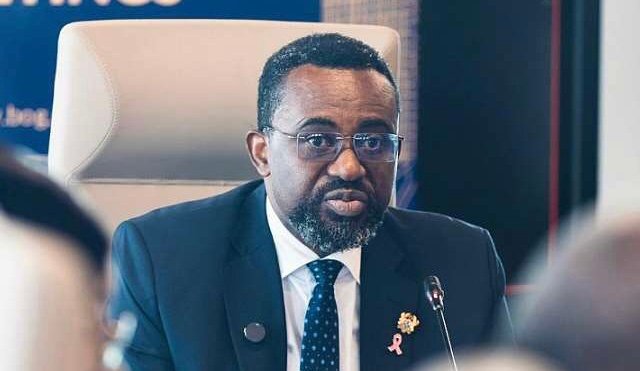
Governor of the Bank of Ghana (BoG), Dr. Johnson Asiama, says a combination of new legislative amendments and tighter economic policies will shield Ghana from a repeat of the severe financial crisis that culminated in the 2022 Domestic Debt Exchange Programme (DDEP).
He gave the assurance at the official listing of First Atlantic Bank on the Ghana Stock Exchange, where he addressed stakeholders on the state of Ghana’s economic recovery and the reforms underpinning it.
Stronger Legal Framework
Dr. Asiama pointed to recent amendments to the Bank of Ghana Act, passed by Parliament, as a major milestone in strengthening the independence and credibility of the central bank. According to him, the revised law limits fiscal dominance, enhances accountability, and reduces the risk of policy slippages that previously weakened macroeconomic stability.
He added that complementary reforms by the Ministry of Finance, including fiscal rules and public financial management measures, are reinforcing the broader economic architecture and improving coordination among key institutions.
Lessons from the 2022 Crisis
Recalling the depth of the downturn, Dr. Asiama noted that Ghana faced what the World Bank described as a “homegrown crisis” barely three years ago. By the end of 2022, inflation had climbed to 54.1 per cent, the cedi had lost more than half of its value between 2022 and 2023, and gross international reserves had declined to less than one month of import cover—one of the weakest positions in decades.
“The crisis severely eroded confidence across the financial system,” he said, explaining that capital markets were particularly hard hit amid fiscal stress and sharp exchange rate volatility.
While the DDEP helped restore debt sustainability, the Governor acknowledged that it came at a high cost to banks, pension funds, and other institutional investors, exposing structural weaknesses in Ghana’s financial system.
Signs of a Firm Recovery
Despite the earlier shocks, Dr. Asiama said the recovery underway is tangible and data-driven. Inflation has eased significantly to 6.3 per cent as of end-November 2025, with projections suggesting it could approach 5 per cent by year-end—levels not seen in many years.
The cedi has also strengthened by over 24 per cent year-to-date, supported by prudent monetary policy, stronger external buffers, and improved fiscal discipline. However, he cautioned against overinterpreting the gains, noting that they partly reflect a correction following a 19 per cent depreciation the previous year.
“This is not an artificial or worrying appreciation,” he explained, stressing that the currency’s performance is backed by improved fundamentals.
Improved Buffers and Growth
Ghana’s gross international reserves now exceed US$11 billion, equivalent to nearly five months of import cover. Meanwhile, economic activity has rebounded, with GDP growth reaching 6.3 per cent in the first half of 2025 and non-oil growth close to 8 per cent—signaling broad-based expansion.
Reform Must Follow Recovery
Dr. Asiama concluded that while the economy is stabilising, sustaining progress will depend on deepening reforms rather than relying on short-term interventions.
“The experience has taught us that lasting stability requires strong institutions, diversified funding sources, deeper markets, and shared responsibility,” he said, emphasizing that recovery must be consolidated with continuous reform to prevent a relapse into crisis.
Source: Africa Publicity