

By: Isaac Christopher Lubogo
1. Introduction: The Question Behind the Slogan
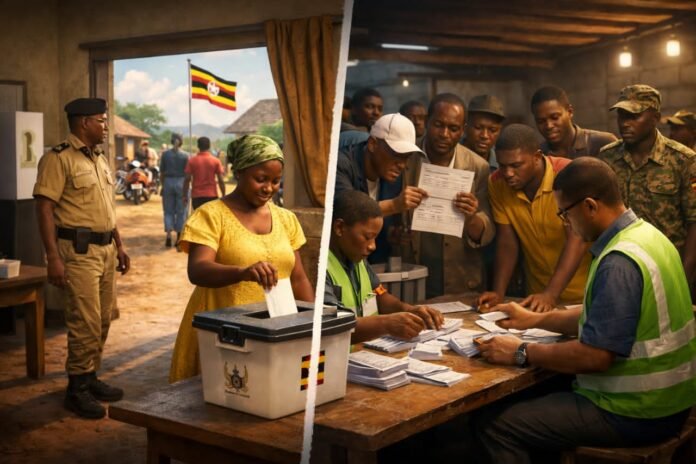
The debate in Uganda—“vote and go home” versus “vote and protect the vote”—is not a debate about disorder versus order. It is, at its core, a dispute about where democratic sovereignty practically resides on polling day: whether it is exhausted at the moment a ballot is cast, or whether it extends to the entire electoral chain, particularly counting, declaration, transmission, and aggregation of results.
This discourse examines the debate in a legally grounded and analytically sober manner, drawing on Uganda’s constitutional and statutory framework, judicial reasoning, and comparative practice from other democracies. It argues that the controversy is less about defiance of the law and more about public trust deficits in electoral custody—and that the Ugandan legal framework itself anticipates, and partly legitimises, the instinct to “protect the vote” through lawful means.
2. The Constitutional Foundation: Voting as a Meaningful Right
Article 59(1) of the Constitution of the Republic of Uganda, 1995 guarantees every citizen of eighteen years and above the right to vote. Crucially, this provision is not framed as a ritualistic entitlement but as a substantive political right, whose value lies in its capacity to influence governance.
Article 61 further mandates the Electoral Commission (EC) to ensure that elections are conducted in a manner that is free and fair. The constitutional promise is therefore twofold: the right to cast a ballot, and the right for that ballot to be honestly counted and reflected in the declared outcome. Any interpretation of electoral conduct that truncates the right at the polling booth, while neglecting the integrity of counting and declaration, risks hollowing out Article 59 of its democratic substance.
3. Statutory Law: What Ugandan Election Laws Actually Provide
(a) Counting at the Polling Station
Under section 49 of the Parliamentary Elections Act and section 49 of the Presidential Elections Act, counting of votes must take place at the polling station immediately after close of polling, and the process must be conducted in the presence of candidates’ agents and other persons lawfully present.
This is critical. Ugandan law deliberately decentralises counting to the polling station as a transparency safeguard. The law does not contemplate secret counting elsewhere; it embeds public visibility into the electoral process.
(b) Declaration and Documentation of Results
The presiding officer is required to complete a declaration of results form (commonly referred to in practice as DR forms) and to provide copies to candidates’ agents. This requirement is not administrative courtesy; it is a statutory accountability mechanism. These forms constitute the legal DNA of election results and form the evidentiary backbone of any election petition.
Thus, Ugandan law itself recognises that the integrity of elections is secured at the polling station, not merely at national tally centres.
(c) Role of Agents and Observers
Sections 47 and 48 of the Parliamentary Elections Act (and equivalent provisions in presidential election law) expressly allow candidates to appoint polling agents to represent their interests at polling stations. These agents are legally entitled to observe voting, counting, and declaration.
This statutory architecture implicitly accepts the logic behind “protecting the vote”: that transparency is best guaranteed by presence, documentation, and verification, not blind trust.
4. The Meaning of “Vote and Go Home” in Law
The phrase “vote and go home” is often defended on grounds of public order. Ugandan electoral law indeed discourages congestion and disorder at polling stations. Voters are not entitled to loiter within the sensitive inner zone of a polling station after voting, as this could compromise secrecy, efficiency, and security.
However, the law does not require citizens to disappear from civic life after voting. The legal expectation is distance, not silence; order, not amnesia. When “go home” is interpreted as total disengagement from the rest of the electoral process, it exceeds what the law requires and collides with the constitutional demand for free and fair elections.
5. Why “Protect the Vote” Persists: Trust Deficit and the Custody Gap
The insistence by many Ugandans on “protecting the vote” arises from a perceived custody gap between:
1. The polling-station truth (counted votes and DR forms), and
2. The final declared national results.
In low-trust electoral environments, citizens seek redundant verification mechanisms—not necessarily to subvert the law, but to ensure that what happens at stage (1) is faithfully transmitted to stage (2). This is not unique to Uganda.
6. Comparative Democratic Benchmarks
(a) Ghana
Ghana’s elections are anchored on polling-station result forms (“pink sheets”), signed by agents and used as the primary reference point in disputes. Public confidence rests heavily on the visibility and integrity of these documents.
(b) Kenya
Kenya’s electoral jurisprudence, especially after the 2017 presidential election petitions, has emphasised the primacy of polling-station results forms (Form 34A). The Supreme Court underscored that aggregation cannot cure defects at the polling-station level. This mirrors Uganda’s statutory insistence on polling-station counting.
(c) United States
In the United States, election transparency is safeguarded through poll watchers, decentralised counting, public canvassing processes, and judicially reviewable certification stages. Citizens are not expected to “just trust” the system; they are provided with procedural visibility.
The common denominator across these democracies is clear: credible elections rely on verifiable procedures, not appeals for passive obedience.
7. Is “Staying Until the Last Vote Is Counted” Lawful in Uganda?
Legally, the answer is nuanced:
Unlawful: Remaining inside polling stations without authority, obstructing voting, intimidating officials, or disrupting order.
Lawful and anticipated: Presence of accredited agents and observers during counting; lawful observation from outside sensitive zones; documentation and transmission of polling-station results.
Thus, “protecting the vote” becomes lawful when it is institutionalised—through agents, observers, documentation, and legal challenge—not when it is improvised through confrontation.
8. The Deeper Issue: Elections as Proof, Not Faith
The Ugandan debate reveals a fundamental democratic insight: legitimacy today is evidence-based. Where citizens are asked to rely solely on trust, suspicion flourishes. Where procedures generate proof, trust follows.
Telling citizens to “vote and go home” without simultaneously strengthening transparency at counting, declaration, and transmission stages risks deepening electoral cynicism. Conversely, enabling lawful verification reduces the perceived need for physical “protection” of votes.
9. Conclusion: Beyond Slogans to Institutional Credibility
The real question is not whether Ugandans should go home or stay behind; it is whether the electoral system is designed so that going home does not mean surrendering sovereignty.
Uganda’s Constitution and electoral laws already point in the right direction: polling-station counting, agent participation, documented results, and judicial oversight. The challenge is not legal deficiency but implementation and trust.
In mature democracies, citizens protect their vote not by confrontation, but because the system itself makes manipulation difficult and detection easy. Uganda’s path forward lies in deepening this architecture—so that voting once is enough, because the law itself does the guarding.