
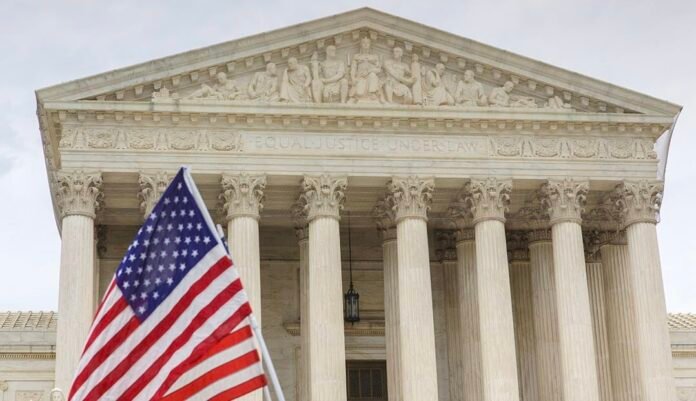
As the U.S. Supreme Court weighs a series of cases that could significantly expand presidential authority, the justices appear prepared to side with President Donald Trump on his power to dismiss officials at independent regulatory agencies. At the same time, the court has sent strong signals that it may resist any ruling that undermines the independence of the Federal Reserve, long viewed as central to economic stability.
The tension between those two positions will come into sharper focus early next year, when the justices hear arguments over Trump’s decision to fire Federal Reserve Governor Lisa Cook. The case has become a flashpoint in a broader legal and political struggle over how much control a president can exert over agencies Congress deliberately insulated from direct political influence.
A Court Open to Expanding Presidential Power
The Supreme Court, which currently has a 6–3 conservative majority, has already allowed Trump to remove several officials from independent agencies while their legal challenges proceed. These actions align with Trump’s long-running view that presidents should have greater authority to shape the executive branch, including agencies created by Congress with statutory job protections.
That approach was evident during arguments in December over Trump’s firing of Rebecca Slaughter, a Democratic member of the Federal Trade Commission (FTC). Slaughter sued after Trump dismissed her despite a federal law dating back to 1914 that permits removal of FTC commissioners only for cause, such as inefficiency or misconduct.
During oral arguments, conservative justices repeatedly questioned whether Congress can constitutionally restrict the president’s ability to fire executive officers. Their comments suggested a willingness to overturn or narrow a 1935 Supreme Court precedent that upheld such protections, potentially reshaping the balance of power between Congress and the White House.
If the court rules for Trump in the FTC case, future presidents could gain broader authority to remove officials at agencies traditionally considered independent, including regulators overseeing labor, communications, and consumer protection.
The Federal Reserve as a Special Case
Despite this apparent momentum, the court has drawn a notable distinction when it comes to the Federal Reserve. In a May order allowing Trump to remove a member of the National Labor Relations Board, the justices emphasized that their decision should not be read as extending to the Fed.
In that order, the court described the central bank as a “uniquely structured, quasi-private entity” rooted in a historical tradition distinct from other regulatory bodies. That language has since become central to arguments that the Fed occupies a constitutionally different category.
Trump’s decision in August to fire Fed Governor Lisa Cook has nonetheless placed that distinction under direct legal pressure. Cook, appointed by former President Joe Biden, was removed after Trump accused her of mortgage fraud prior to joining the Fed—an allegation she has denied. Her lawyers argue that the stated justification was a pretext for removing her due to disagreements over monetary policy.
Arguments in Cook’s case are scheduled for January 21, and the outcome could determine whether presidents can influence interest-rate policy indirectly by reshaping the Fed’s leadership.
Why Fed Independence Matters
For decades, lawmakers and economists across party lines have argued that the Federal Reserve must remain insulated from day-to-day politics. Its authority to set interest rates and manage the money supply has far-reaching consequences for inflation, employment, and financial markets.
Justice Brett Kavanaugh, a leading conservative voice on administrative law, has previously acknowledged this concern. In a 2009 law review article, he wrote that while many agencies should remain accountable to the president, the Federal Reserve might warrant special insulation because of its ability to directly affect the short-term functioning of the U.S. economy.
That view surfaced again during the FTC arguments, when Kavanaugh pressed the Trump administration’s lawyer on whether its legal theory could jeopardize the Fed. He openly stated that he shared concerns about putting central bank independence at risk.
The administration responded by emphasizing that it considers the Fed unique and that Trump claims he fired Cook “for cause,” rather than over policy disagreements—a key distinction it argues separates her case from the FTC dispute.
Legal Uncertainty Ahead
Legal scholars say the Supreme Court appears inclined to carve out an exception for the Federal Reserve even if it rules broadly in Trump’s favor in other cases. However, critics argue that such an exception lacks a clear constitutional foundation.
Some experts note that the Fed is governed by a multi-member board that, structurally, resembles other independent commissions. They warn that creating a special category for the central bank may rely more on tradition and policy preference than on consistent legal principles.
Business groups such as the U.S. Chamber of Commerce have supported the idea of a Fed exception, citing historical precedents of U.S. monetary policy being set by bodies operating outside presidential control. Others counter that those comparisons oversimplify the Fed’s modern role and authority.
A Defining Moment for Governance
Together, the FTC and Fed cases place the Supreme Court at the center of a fundamental debate over executive power, congressional authority, and economic governance. A ruling that expands presidential removal power while preserving Fed independence would reshape administrative law in lasting ways—strengthening the White House while leaving one powerful institution largely untouched.
As the January arguments approach, the justices face a delicate task: clarifying the scope of presidential control without destabilizing the financial system. The decisions could define the boundaries of executive authority for decades to come.
Source:Africa Publicity