
The United States has accused Rwanda of violating a recently signed peace agreement aimed at stabilising eastern Democratic Republic of Congo (DRC), escalating diplomatic pressure on Kigali as fighting intensifies in the mineral-rich region.
U.S. Secretary of State Marco Rubio said on Saturday that Rwanda’s actions in eastern Congo are incompatible with the commitments it made under the Washington Accords, a peace deal signed earlier this month under the auspices of U.S. President Donald Trump. Rubio’s remarks mark one of the strongest public warnings from Washington since the agreement was concluded.
“Rwanda’s actions in eastern DRC are a clear violation of the Washington Accords signed by President Trump,” Rubio wrote in a post on X. “The United States will take action to ensure promises made to the President are kept.”
Rising Tensions After Washington Deal
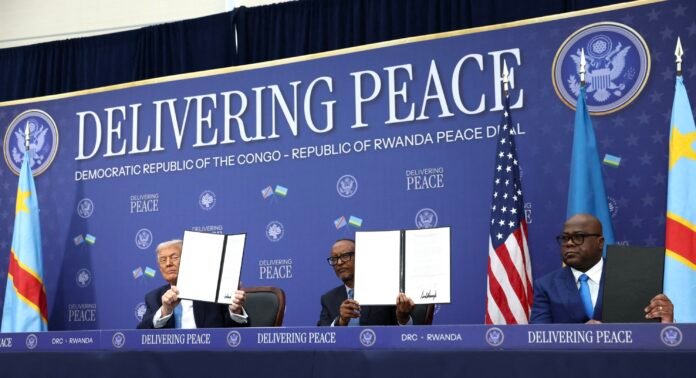
The Washington Accords were signed on December 4 by the presidents of Rwanda and the Democratic Republic of Congo during talks hosted in the U.S. capital. The agreement was intended to reduce cross-border tensions, curb armed group activity in eastern Congo and create a pathway toward de-escalation after years of conflict that has displaced millions of civilians.
Despite the deal, violence has continued in North Kivu and surrounding areas, where the M23 rebel group has made fresh advances. The United States and the United Nations say the group receives backing from Rwanda, a claim Kigali has repeatedly denied.
U.S. officials now warn that the renewed fighting threatens to undermine months of diplomatic efforts and risks plunging the region back into broader instability.
U.S. Accusations at the United Nations
On Friday, a day before Rubio’s statement, the United States delivered a blunt message at the United Nations, accusing Rwanda of fuelling conflict in eastern Congo by supporting M23 rebels. American diplomats said the group’s advances are directly at odds with the spirit and letter of the Washington agreement.
“The continuation of hostilities puts peace efforts at risk,” a U.S. representative told the Security Council, adding that regional stability cannot be achieved while armed groups continue to gain territory with outside support.
The U.N. has long documented allegations of Rwandan assistance to M23, including arms supplies and troop support. Rwanda has consistently rejected the accusations, saying its security concerns stem from the presence of hostile militias in eastern Congo, including remnants of groups linked to the 1994 genocide.
Rwanda and Congo at Odds
Relations between Rwanda and the DRC have been strained for decades, largely due to violence in Congo’s eastern provinces, where numerous armed groups operate amid weak state control. The M23 rebellion, which resurfaced in recent years after being dormant for nearly a decade, has become one of the most destabilising forces in the region.
The Congolese government accuses Rwanda of seeking to exploit eastern Congo’s vast mineral wealth, including coltan, gold and cobalt, by backing proxy forces. Rwanda denies those claims and argues that Congo has failed to neutralise militias that threaten Rwandan security.
The December peace deal was meant to address these mutual accusations by committing both sides to respect territorial sovereignty and support regional security mechanisms. However, continued clashes have cast doubt on whether either side can fully implement the agreement.
Humanitarian Consequences
The renewed fighting has worsened an already severe humanitarian crisis. Eastern Congo is home to one of the world’s largest populations of internally displaced people, with millions forced from their homes by years of conflict.
Aid agencies warn that escalating violence could further disrupt humanitarian access, increase civilian casualties and deepen food insecurity. Hospitals and clinics in conflict-affected areas are already struggling to cope with the influx of wounded civilians.
Washington Signals Possible Action
Rubio did not specify what actions the United States might take in response to what it views as Rwanda’s non-compliance. However, analysts say options could include diplomatic pressure, suspension of security cooperation or targeted sanctions against individuals deemed responsible for undermining peace.
The Trump administration has invested political capital in positioning itself as a broker of international peace deals, including in regions where previous efforts have stalled. Failure to enforce the Washington Accords could weaken U.S. credibility in future negotiations, officials and experts say.
For now, it remains unclear how Rwanda will respond publicly to Rubio’s remarks. Kigali has previously defended its actions as necessary for national security and has criticised what it describes as international bias toward Congo.
The Democratic Republic of Congo, meanwhile, has welcomed stronger U.S. language, arguing that sustained international pressure is essential to stopping armed groups in the east.
As fighting continues on the ground, diplomats say the coming weeks will be critical. Whether the Washington Accords can survive this early test may depend on whether the United States and regional partners can persuade both sides—especially Rwanda—to recommit to de-escalation.
Without tangible progress, observers warn that eastern Congo risks slipping back into a wider conflict, once again leaving civilians to bear the brunt of a long-running and deeply entrenched war.
Source:Africa Publicity