

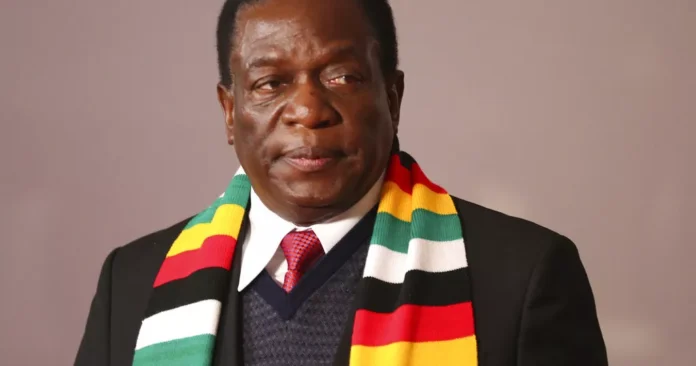
Zimbabwean President Emmerson Mnangagwa has unexpectedly dismissed Mines and Mining Development Minister Winston Chitando, replacing him with his deputy, Polite Kambamura, in a late-night announcement that signals a renewed push to tighten government control over one of the country’s most critical economic sectors.
In a brief statement released Monday evening, the Office of the President and Cabinet confirmed Chitando’s removal but did not provide reasons for the decision. The absence of explanation has fueled speculation about tensions within the ministry and the broader government as Zimbabwe attempts to reposition itself as a competitive destination for global mining investment.
Kambamura, who has served as deputy minister since 2018, was sworn in immediately and is now responsible for steering a sector that contributes more than 60% of the country’s export earnings. His appointment places him at the centre of ongoing efforts to overhaul regulatory frameworks, curb illicit mining activities, and expand production of strategically important minerals.
A Sudden End to Chitando’s Long Tenure
Chitando, a veteran mining executive before joining government, was appointed in 2017 shortly after Mnangagwa took office. During his nearly seven years in the post, he championed Zimbabwe’s drive to grow mineral revenues to US$12 billion per year—a target the government has repeatedly said remains within reach despite structural obstacles and fluctuating global commodity prices.
He oversaw efforts to formalise artisanal miners, attract new foreign investment, and stabilise output in the gold, platinum and chrome industries. Under his leadership, Zimbabwe also became a rising player in the global lithium market, attracting significant investment from companies in China, South Africa and Australia.
However, Chitando’s tenure was also marked by criticism. Lawmakers and industry groups occasionally accused the ministry of slow policy implementation, bureaucratic delays and unclear licensing procedures. Local communities in mining areas raised concerns about environmental degradation, while civil society organisations demanded greater transparency in agreements between the government and foreign companies.
Although the presidency did not link Chitando’s dismissal to any specific issue, analysts say the decision may reflect Mnangagwa’s desire to accelerate reforms ahead of new economic targets set for the next two years.
Kambamura Assumes a High-Stakes Portfolio
The incoming minister, Polite Kambamura, has previously focused on artisanal mining policy and the government’s campaign against gold smuggling—an activity that the Reserve Bank of Zimbabwe has acknowledged drains hundreds of millions of dollars from the formal economy each year. His experience in these areas suggests that combating leakages and strengthening regulatory enforcement will be among his top priorities.
Kambamura takes office at a moment when global interest in Zimbabwe’s minerals is rising sharply. The country holds some of the world’s largest reserves of platinum group metals, high-grade lithium deposits essential for electric vehicle batteries, significant gold belts, and expanding prospects in coal-bed methane and rare earth elements.
International investors—particularly from China, the United Arab Emirates, the United Kingdom and South Africa—have intensified exploration and acquisition efforts over the past three years. The government has framed this interest as a pillar of its economic recovery strategy, emphasizing that mining growth is essential for stabilising the country’s currency, increasing employment and supporting long-term infrastructure development.
Strategic Timing and Political Implications
The timing of the reshuffle has drawn attention within political and business circles. Mnangagwa has recently hinted at the need for “greater efficiency” in ministries overseeing key economic sectors, including mining, energy and agriculture. The abrupt change may also be part of broader adjustments expected in the coming months as the president seeks to consolidate his administration’s agenda following the 2023 elections.
For investors operating in Zimbabwe’s mining sector, the leadership change introduces both uncertainty and expectation. Industry executives say they hope Kambamura will streamline licensing processes, enhance environmental oversight and support efforts to ensure stability in mining communities, where disputes over land and compensation have occasionally delayed projects.
The Mines Ministry has not yet issued a statement outlining its immediate plans under the new leadership, but officials say Kambamura will meet senior department heads and key stakeholders in the coming days.
Source:Africa Publicity