

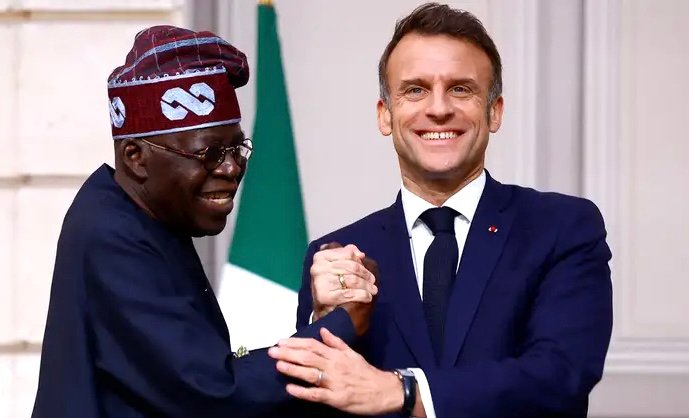
France has announced a renewed commitment to support Nigeria as the West African nation faces a mounting security crisis, characterized by mass kidnappings, terrorist attacks, and escalating violence in its northern and central regions. The pledge followed a phone call between French President Emmanuel Macron and Nigerian President Bola Tinubu, highlighting a potential deepening of bilateral cooperation aimed at stabilizing the country.
In a statement shared on X (formerly Twitter), Macron expressed solidarity with Nigeria, noting that at Tinubu’s request, France would bolster its collaboration with Nigerian authorities and provide support for civilians affected by the unrest. “At his request, we will strengthen our partnership with the authorities and our support for the affected populations,” Macron said, urging other international partners to join efforts to address the crisis.
Nigeria Faces an Unprecedented Security Emergency
The security situation in Nigeria has reached critical levels. Recent reports indicate that more than 400 people have been abducted in the past fortnight, including entire school classes, families, and local community members. Among the latest rescues were 100 students freed on Monday, following a mass kidnapping at a Catholic school in the country’s west on November 21.
Analysts attribute the surge in violence to multiple intertwined threats. Islamist insurgent groups, including Boko Haram, continue to operate in the northeast, while armed bandit gangs have intensified raids in northwestern states. Central regions also experience recurring clashes between herders and farmers, adding layers of communal tension. Nigerian security agencies report hundreds of deaths and widespread displacement as these incidents persist.
In response, President Tinubu has declared a national state of emergency, authorized the recruitment of 50,000 additional police officers, and committed to deploying forest guards and extra security forces to areas most affected by violence. Despite these measures, communities remain fearful, as kidnappings, ambushes, and sudden mass abductions continue unabated.
Scope of France’s Support
French officials stressed that the renewed partnership will not involve deploying combat troops to Nigeria, distinguishing it from past military interventions in the Sahel region. Instead, France intends to focus on intelligence sharing, counterterrorism training, logistical assistance, and humanitarian aid for civilians caught in the conflict.
Security experts suggest that Paris’s approach addresses critical gaps in Nigeria’s current response, including intelligence capacity, emergency logistics, and protection for vulnerable populations. Tinubu welcomed the assistance, noting that international cooperation is essential as Nigeria struggles to rebuild its security framework amid growing criminal networks and insurgent activity.
Regional Implications
The Nigeria-France partnership carries significance beyond Nigeria’s borders. Escalating insecurity has ripple effects across West Africa, disrupting trade, forcing refugee flows, and challenging regional stability. Humanitarian organisations warn that unchecked violence hampers education, agriculture, and social services, creating long-term developmental setbacks.
By emphasizing intelligence and civilian protection, France aims to mitigate some root causes of instability. Yet questions remain about whether external support alone—without direct military intervention—can effectively curb entrenched insurgent networks and armed gangs. Additionally, the effectiveness of the partnership will depend on Nigeria’s ability to strengthen institutions and implement reforms rapidly.
Hope Amid Uncertainty
While the French pledge offers a measure of hope, challenges persist. Families of kidnapped children demand faster rescues, communities in rural areas remain vulnerable, and internally displaced populations struggle to rebuild livelihoods. Analysts caution that success will require not only foreign support but also strong domestic governance, accountability, and the resilience of affected communities.
Source:Africa Publicity