

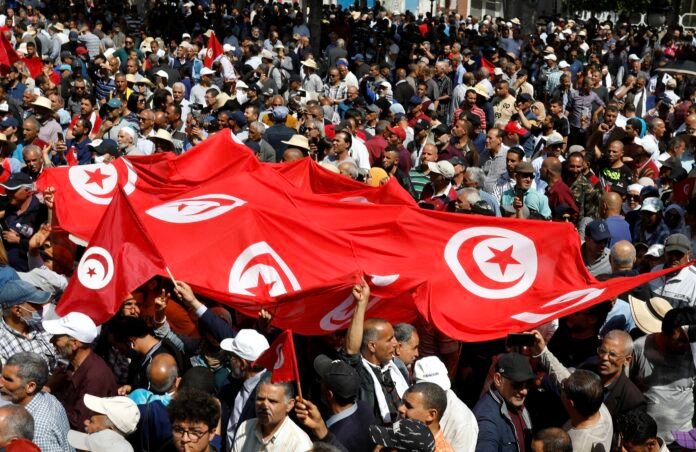
Tunisia’s largest labor union, the Tunisian General Labor Union (UGTT), has announced a nationwide strike set for January 21, signaling escalating tensions between the government and civil society over President Kais Saied’s ongoing consolidation of power. The strike, the first since Saied assumed sweeping authority, is aimed at protesting his crackdown on dissent and pressing for wage negotiations amid mounting economic hardship.
The UGTT, which represents over one million members, warned that the strike could paralyze key public services, intensifying the strain on a government already struggling with budget deficits, inflation, and a deepening cost-of-living crisis. The union called the move a necessary response to “the erosion of civil liberties and the silencing of political debate.”
“We are not intimidated by threats or prisons. We do not fear jail,” UGTT General Secretary Nourredine Taboubi told reporters Thursday after leading a union protest. “We will continue our struggle for workers’ rights, democracy, and social justice.”
Background: Saied’s Power Grab
Since July 2021, President Saied has ruled Tunisia by decree, following his suspension of parliament in what he described as an anti-corruption and anti-mismanagement measure. Critics, however, have denounced it as a coup that undermined the democratic gains made since the 2011 revolution, which ended decades of autocratic rule under former President Zine El Abidine Ben Ali.
Rights groups have accused Saied of systematically dismantling opposition parties, sidelining civil society organizations, including the UGTT, and tightening control over the judiciary. Several opposition leaders and journalists have been detained under laws that critics argue suppress free speech and political dissent. Saied maintains that his actions are legally justified and insists that “no one is above the law.”
UGTT’s Growing Frustration
The UGTT initially supported Saied’s 2021 suspension of parliament, hoping it would bring stability and address corruption. However, the union has since become one of his most vocal critics, warning that the country is moving toward authoritarianism. The labor group stresses that economic stagnation, rising unemployment, and deteriorating public services are fueling widespread social discontent, making the president’s policies increasingly untenable.
“Tunisia cannot achieve progress if civil liberties are curtailed and dialogue is stifled,” Taboubi said. “We are mobilizing not only for workers’ rights but for the democratic principles that safeguard the country’s future.”
The strike is expected to affect public administration, transportation, education, and healthcare, potentially leaving schools and hospitals operating at minimal capacity. Observers warn that disruptions could escalate public frustration and provoke clashes between security forces and demonstrators, particularly as inflation has pushed food and fuel prices to record highs.
Economic and Political Implications
Tunisia’s economy has struggled in recent years, burdened by high debt, a declining tourism sector, and reduced foreign investment. The International Monetary Fund (IMF) has urged structural reforms and political stability as prerequisites for financial aid. However, ongoing political tensions and the lack of a functioning legislative body complicate negotiations with international lenders, raising fears of further economic instability.
Analysts suggest that the UGTT strike represents more than a labor dispute; it is a political statement and a challenge to Saied’s vision of centralized power. By calling a nationwide strike, the UGTT is leveraging its historical role as a key actor in Tunisia’s post-2011 democratic transition, demonstrating that civil society remains a potent force despite state repression.
Outlook
With the strike looming, Tunisia faces a critical test of its political stability. Government officials have yet to indicate whether they will engage with the union’s demands or take measures to prevent mass walkouts. Meanwhile, Tunisians continue to grapple with rising living costs, weakened public services, and growing concern over the trajectory of the country’s democracy.
Observers note that the January 21 strike could mark a defining moment for Tunisia, potentially shaping the balance between authoritarian control and citizen-led resistance in the months ahead.
Source:Africa Publicity