

By: Isaac Christopher Lubogo
Abstract
This article examines the political, legal, and symbolic implications of a viral photograph depicting a young National Unity Platform (NUP) supporter mimicking a sniper pose with a prop during a political rally in Luweero District, Uganda. Drawing on theories of visual politics, digital repression, and securitised governance, the analysis demonstrates how seemingly benign symbolic acts become entangled in authoritarian state logics, risk amplification, and narrative contestation. The study situates the incident within Uganda’s broader landscape of militarised political policing, youth-driven digital dissent, and shrinking civic space. The article argues that the “sniper-pose” photo serves as a diagnostic lens into the fragile boundary between creative resistance and criminalised expression under contemporary electoral authoritarianism.
Keywords: visual politics, digital repression, securitisation, Uganda, youth activism, political imagery, dissent.
1. Introduction
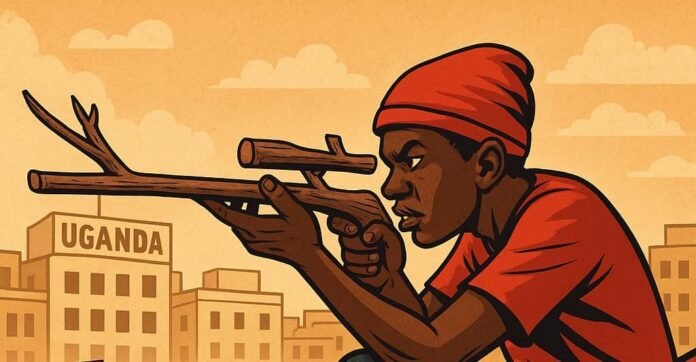
On a recent afternoon in Luweero District, a photograph circulated widely on Ugandan social media platforms: a young National Unity Platform (NUP) supporter perched above a crowd, aiming a rifle-like object fashioned from yam stems, in a pose reminiscent of a trained sniper. The image immediately ignited online debate and drew mixed reactions from opposition supporters, regime allies, and independent observers. Although the object was non-functional, the image resonates powerfully within Uganda’s securitised political landscape.
This article provides an academic analysis of this viral image. It argues that the interpretive life of protest imagery in Uganda is inseparable from the country’s authoritarian drift, militarised policing, digital surveillance, and youth-driven resistance cultures. The “sniper-pose youth” becomes a site through which broader tensions between performance, repression and representation can be understood.
2. Theoretical Framework: Visual Politics and Symbolic Resistance
2.1 Images as political acts
Scholars of visual politics contend that images do not simply document political events; they actively shape political meaning, mobilise emotion, and influence narrative framing (Bleiker, 2018). Protest imagery in particular has been described as performing “embodied dissent,” where the body itself becomes a medium of political communication (Sontag, 2003).
In the Ugandan case, the youth’s pose visually invokes militarised resistance, dramatizing a form of symbolic counter-power. This aligns with research showing that political imagery can condense complex histories into single frames that become “iconic”—standing in for broader grievances (Hariman & Lucaites, 2007).
2.2 Youth and the aesthetics of resistance
African youth movements increasingly use visual and performative tactics to contest exclusionary governance (Honwana, 2019). These acts often merge cultural creativity—music, fashion, graffiti, theatre—with political messaging. For Uganda’s NUP movement, whose identity is heavily youth-centred, such symbolism is central. As Tufekci (2017) notes, digital-era protest movements rely heavily on powerful visuals for rapid mobilisation and narrative assertion.
3. Context: Uganda’s Securitised Political Environment
3.1 Militarised governance and political policing
Uganda’s security forces have a documented history of using lethal and excessive force to suppress opposition mobilisation. The OHCHR (2020; 2025) has repeatedly condemned the Ugandan government’s violent crackdowns on opposition gatherings, most notably the November 2020 protests in which at least 54 civilians were killed.
This securitised environment shapes how symbolic acts—even playful ones—are interpreted. As Abrahamsen and Williams (2014) argue, security politics in hybrid regimes often blur distinctions between symbolic dissent and actual threat.
3.2 Criminalisation of dissent
Research on authoritarian legalism shows that repressive regimes increasingly rely on law-shaped violence—the use of legal instruments to justify extralegal crackdowns (Ginsburg & Moustafa, 2008). In Uganda, Public Order Management Act (POMA), anti-terrorism provisions, and broad interpretations of “unlawful assembly” have been used to criminalise dissent.
Within this framework, a symbolic pose with a toy gun may be reframed as evidence of “militia training,” “incitement,” or “intent to commit violence”—even without factual basis.
4. Empirical Analysis: The Viral “Sniper-Pose Youth” Photo
4.1 Description of the event
The youth was photographed atop a building during an NUP mobilisation event in Luweero, holding a rifle-shaped object made of yam stems—confirmed by local media and eyewitness reports. The photo was circulated by NUP-affiliated pages and rapidly amplified across X, Facebook, and WhatsApp.
4.2 Digital virality and interpretation
Visual content spreads rapidly in Uganda’s political digital ecosystem, often detached from context. Research has documented repeated patterns of image misuse in Uganda’s political cycles, with protest photos frequently recaptioned or misattributed (AFP Fact Check, 2022).
The “sniper-pose” image circulated in three dominant interpretive frameworks:
1. Heroic Frame – by opposition supporters who regarded the youth as symbolic of resistance and vigilance.
2. Militant/Threat Frame – by pro-regime actors who portrayed the image as proof of NUP’s alleged violent ambitions.
3. Critical Frame – by analysts concerned about the implications of young activists engaging in militarised aesthetics.
4.3 Digital repression risks
Digital repression research shows that viral images can become “evidence artefacts” used to identify, track or prosecute activists (Feldstein, 2021). Uganda’s security agencies maintain a sophisticated digital monitoring apparatus, particularly during election seasons.
Thus, despite the symbolic nature of the pose, the individual becomes exposed to:
Targeted surveillance
Arbitrary arrest
Criminalisation based on visual performance
This aligns with OHCHR findings that Uganda increasingly uses pre-emptive arrests and surveillance to stifle political opposition (OHCHR, 2025).
5. Symbolic Militancy vs. Criminalisation: The Legal Ambiguity
5.1 Symbolic weapons under Ugandan law
Ugandan law criminalises possession of “firearms or imitation firearms” only in specific contexts (Firearms Act, Cap. 299). A yam-stem prop does not meet this threshold.
However, under Uganda’s public order and anti-terrorism regulatory framework, symbolic militarised performance may be construed as:
Incitement to violence
Threatening behaviour
Participation in an unlawful assembly
The ambiguity gives authorities discretionary latitude to act repressively.
5.2 Precedent for misinterpreting symbolism
Previous cases have seen youth arrested for:
Wearing red berets classified as “military attire”
Performing symbolic “military drills” during protests
Satirical artistic performances misread as threats
The “sniper-pose” fits this pattern of symbolic acts facing disproportionate security interpretation.
6. The Politics of Narrative: Competing Claims to Legitimacy
The image functions as a battlefield of narratives:
Opposition stories frame the youth as brave and creative.
State narratives frame him as dangerous or militant.
Global human rights narratives see him as vulnerable to repression.
Hariman and Lucaites (2007) note that such images become “nodes of political identity,” shaping how groups imagine themselves and their adversaries. In this case, the photo reinforces the generational insurgency of Uganda’s youth, while simultaneously offering the state a pretext to reassert coercive power.
7. Implications for Uganda’s Political Future
7.1 Shrinking civic space
The image’s potential to trigger surveillance and criminalisation contributes to the broader climate of fear documented by OHCHR and civil society organisations.
7.2 Youth radicalisation vs. state overreach
Symbolic militarisation may embolden some youth but also increases vulnerability, exacerbating the cycle of repression and resistance.
7.3 Visual resistance as double-edged sword
Images that mobilise can also incriminate. Their power is both weapon and wound.
8. Conclusion
The viral “sniper-pose youth” photo is a microcosm of Uganda’s contemporary political contradictions. It exemplifies how youth deploy symbolic creativity to assert agency in a tightly policed political environment, yet how such visuals also expose them to digital surveillance, legal ambiguity, and securitised repression. Within Uganda’s hybrid authoritarian context, images not only represent politics—they become political actors themselves.
This analysis underscores the need for deeper examination of the visual economy of dissent in East Africa. It also calls for protection of expressive freedoms and a rethinking of how state security apparatus interprets symbolic acts in a democratic society. Unless safeguarded, expressive youth politics will continue to oscillate between creativity and criminalisation, reflecting the broader democratic tension at the heart of Uganda’s political evolution.
References (Authentic Sources)
AFP Fact Check (2022). Fact Check: Misuse of images in Ugandan political context.
Abrahamsen, R., & Williams, M. (2014). Security Beyond the State: Private Security in International Politics. Cambridge University Press.
Bleiker, R. (Ed.) (2018). Visual Global Politics. Routledge.
Feldstein, S. (2021). The Rise of Digital Repression: How Technology is Reshaping Power, Politics, and Resistance. Oxford University Press.
Ginsburg, T., & Moustafa, T. (2008). Rule by Law: The Politics of Courts in Authoritarian Regimes. Cambridge University Press.
Hariman, R., & Lucaites, J. (2007). No Caption Needed: Iconic Photographs, Public Culture, and Liberal Democracy. University of Chicago Press.
Honwana, A. (2019). Youth and Revolution in Tunisia. Zed Books.
OHCHR (2020–2025). Reports on Civic Space and Political Violence in Uganda. United Nations Office of the High Commissioner for Human Rights.
Sontag, S. (2003). Regarding the Pain of Others. Farrar, Straus and Giroux.
Tufekci, Z. (2017). Twitter and Tear Gas: The Power and Fragility of Networked Protest. Yale University Press.
Uganda Firearms Act, Cap. 299.
# Suigeneris