

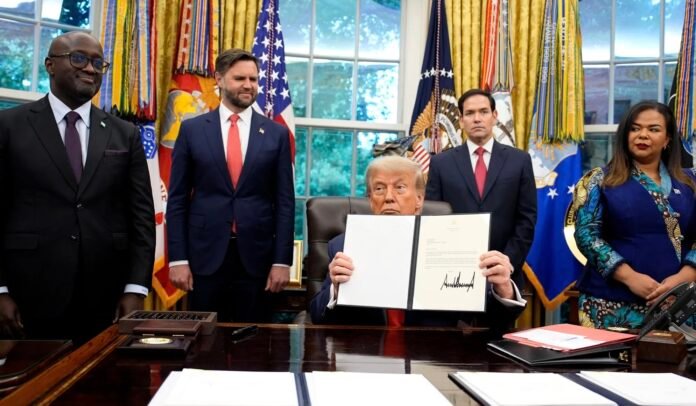
U.S. President Donald Trump will host Félix Tshisekedi of the Democratic Republic of the Congo (DRC) and Paul Kagame of Rwanda in Washington on December 4 to sign a major pact aimed at furthering peace efforts in eastern Congo and laying the groundwork for economic cooperation.
Under the agreement — building on a prior June accord — the two countries are expected to reaffirm commitments to a regional economic integration framework and to measures designed to stabilize the conflict-ridden eastern DRC. The deal is intended to address decades of violence rooted in ethnic tensions, rebel insurgencies, and competition over the region’s mineral resources. 
The region has seen intense fighting in 2025, with the rebel M23 capturing major cities including Goma and Bukavu. The conflict has caused large-scale displacement and humanitarian suffering. 
The Washington accords will also potentially open the door to Western investment in the DRC’s vast mineral reserves — including cobalt, lithium, gold and other critical resources — which are vital for technologies from electric vehicles to electronics. U.S. interest in these resources is one reason Washington has increased its diplomatic engagement in the region. 
However, analysts warn that despite this diplomatic push, the fundamental causes of conflict — ethnic divisions, rebel group presence, and disputes over resource control — remain unresolved. The rebel group M23 is not party to the Washington meeting or the deal, and violence has continued in parts of eastern Congo even as talks advance. 
As leaders gather in Washington, many observers view the deal as a potentially important—but fragile—step toward peace and stability, with success depending on follow-through on troop withdrawals, disarmament of armed groups, and fair management of resource exploitation.
Source:Africa Publicity