
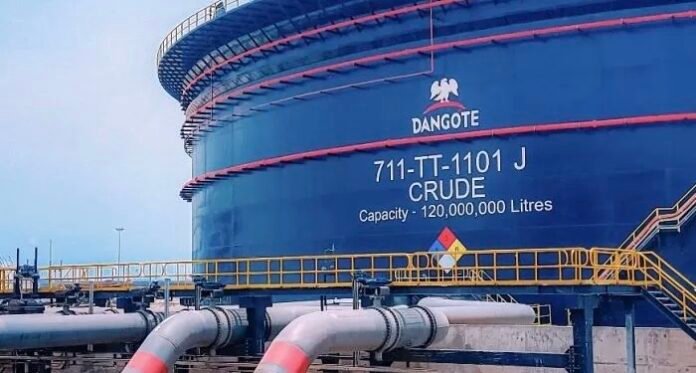
Nigeria’s Dangote Petroleum Refinery has pushed back against recent data released by the country’s downstream regulator, stating that it is fully capable of supplying up to 1.5 billion litres of petrol per month and is ready to prove it through independent verification. The refinery, which is Africa’s largest single-train facility and one of the biggest in the world, maintained that it can already meet a substantial portion of Nigeria’s domestic fuel needs and could play an even larger role in reducing the country’s dependence on imported petroleum products.
The statement was released after the Nigerian Midstream and Downstream Petroleum Regulatory Authority (NMDPRA) published figures suggesting that the Dangote Refinery was supplying only about 18.03 million litres of petrol per day. That figure amounts to roughly 540 million litres per month, just a little over one-third of the volume Dangote claims it is able to deliver. The gap between the two estimates has triggered debate over the true capacity of local refining in Nigeria and has revived concerns about the country’s fuel supply arrangements.
According to Nigeria’s regulators, national petrol demand currently stands at approximately 55 million litres per day. This is equivalent to around 1.67 billion litres per month, meaning that Dangote’s stated capacity of 1.5 billion litres monthly would cover nearly 90% of the country’s total petrol consumption. The refinery also announced that its output is expected to increase further, reaching up to 1.7 billion litres per month from February 2026 onwards. If achieved, this level of production would be enough not only to meet domestic needs but also to create surplus for export.
In an effort to settle the dispute over actual output levels and improve transparency, Dangote Refinery has formally invited officials of the NMDPRA to visit its facilities starting from December 1. The company said regulators would be allowed to monitor fuel processing and loading activities, validate daily production data, and publish verified figures for the public to see. The move is aimed at clearing doubts raised by the regulator’s report and at demonstrating the refinery’s operational strength.
The disagreement between the refinery and the regulator comes at a critical moment. Only a month ago, the Nigerian government reversed its earlier plan to ban the importation of refined petroleum products, including petrol. That plan was largely dropped due to concerns that local refineries, including Dangote, might not be able to meet the country’s enormous fuel demand on their own. The government’s decision allowed fuel importers to continue bringing in petrol to prevent shortages and price shocks at filling stations.
Dangote’s latest announcement appears to directly challenge that assumption. The company insists it has both the technical capacity and the raw materials needed to produce fuel at a much higher rate but has been hampered by operational and regulatory challenges. Among its key concerns are delays in the clearance of vessels carrying refined products and restrictions affecting the importation of crude oil, blending components, and other essential feedstocks required for refining.
“These delays disrupt operations and increase costs, which ultimately affects customers,” the company stated, warning that slow approvals at ports and bureaucratic obstacles are making it harder to operate at full efficiency. Dangote urged the NMDPRA and other relevant government agencies to speed up clearance processes, ensure smooth access to raw materials, and support the refinery’s efforts to supply the domestic market.
The Dangote Refinery, located in the Lekki Free Trade Zone near Lagos, was developed at an estimated cost of more than $19 billion. It is designed to process 650,000 barrels of crude oil per day when operating at full capacity. In addition to petrol, the facility is capable of producing aviation fuel, diesel, and other petroleum products. It has been presented as a strategic national asset that could significantly reduce Nigeria’s reliance on imported fuel, save foreign exchange, and generate jobs.
Nigeria, despite being one of Africa’s largest crude oil producers, has long depended on imported refined fuel due to the poor condition of its state-owned refineries. This dependence has strained government finances and exposed the country to fluctuations in international oil prices and foreign currency shortages. With the Dangote Refinery now operational, many Nigerians had hoped that fuel shortages, long queues at filling stations, and sharp price increases would become a thing of the past.
However, the current dispute between Dangote and the NMDPRA highlights the complexities involved in overhauling Nigeria’s energy supply system. Experts say the situation underscores the need for better coordination between private investors and government agencies. Transparency, reliable data, and consistent policies will be required to fully unlock the potential of local refining.
Industry analysts also point out that even if Dangote produces at its maximum claimed capacity, other factors such as fuel distribution, transportation, pricing, and regional demand differences could still create challenges. Efficient pipelines, storage facilities, and trucking networks will be essential to ensure fuel reaches all parts of the country without delay or inflated costs.
As December approaches, attention will now turn to the planned verification visit by the regulator. The results of the validation process could influence future government decisions on fuel imports, pricing regulations, and investment in additional refining infrastructure. For many Nigerians, the hope is simple: that local production will finally bring more stable fuel supplies and reduce the economic pressure caused by years of dependency on foreign refined products.
Source:Africa Publicity