

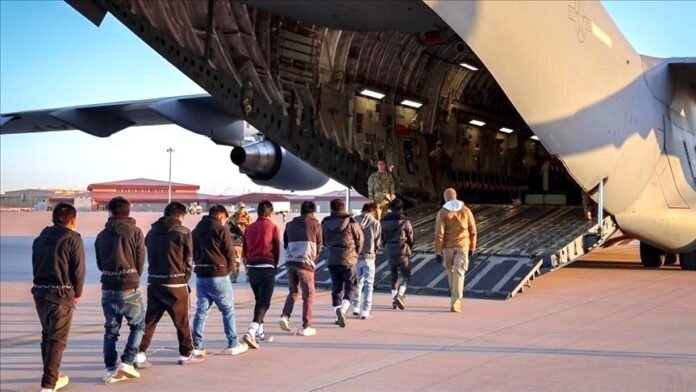
Eswatini’s finance minister has confirmed that the country received $5.1 million from the United States under a confidential agreement that required the kingdom to accept migrants deported from the U.S., including individuals who are not Swazi nationals. The arrangement forms part of a broader initiative launched during former U.S. President Donald Trump’s administration to increase removals of undocumented immigrants.
The southern African nation is one of several on the continent—alongside South Sudan, Ghana and Rwanda—that agreed to take in third-country deportees. However, many of the agreements have remained undisclosed, prompting growing public pressure for transparency and accountability.
Finance Minister Neal Rijkenberg said via text message that the payment amount is accurate, but added that the deal was negotiated directly by the prime minister’s office. He noted that he had not been informed of the arrangement until after it was finalized. His limited knowledge of the agreement has fueled concerns among opposition groups and civil society about the lack of institutional oversight.
The agreement, a copy of which Reuters has reviewed though not independently verified, was reportedly signed on May 14 in Mbabane. It states that the U.S. would provide $5.1 million to support Eswatini’s border security and migration-management systems, while Eswatini would accept up to 160 deported migrants from third countries.
Both governments have declined to comment on the authenticity of the document. A spokesperson for the U.S. State Department reiterated that Washington does not discuss confidential diplomatic exchanges but emphasized that implementing the Trump-era immigration agenda remained a high priority at the time the deal was made.
So far, at least 15 migrants from countries including Vietnam, Cuba, Laos, Yemen, and the Philippines have been transferred to Eswatini under the arrangement. Most are being held in detention facilities, with one individual reportedly repatriated to Jamaica.
The deal has triggered a legal challenge in Eswatini, where human-rights advocates argue that the government acted unconstitutionally by entering into an agreement of such magnitude without public disclosure or parliamentary approval. Critics also warn that detaining foreign deportees may expose Eswatini to humanitarian and security risks if clear reintegration or resettlement plans are not established.
The controversy has intensified calls for Eswatini’s government to clarify its obligations under the agreement and to detail how the $5.1 million will be used to strengthen the country’s migration infrastructure.
Source:Africa Publicity