

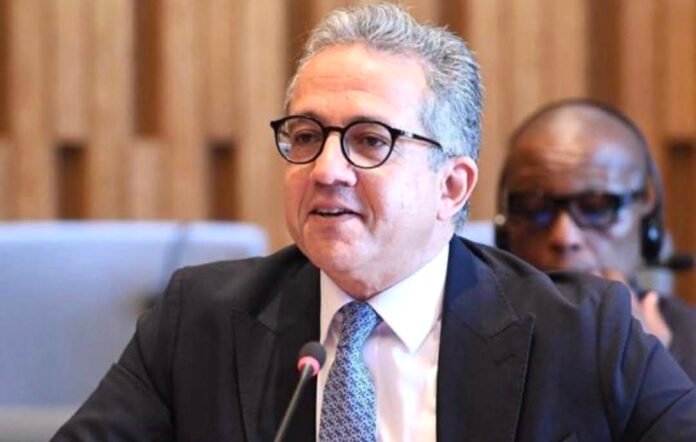
Egypt’s former tourism and antiquities minister, Khaled El-Enany, is expected to be formally appointed as the Director-General of UNESCO this week, even as cultural conservation groups continue to challenge his record on safeguarding heritage sites in Egypt.
El-Enany, 54, secured 55 votes out of 58 at the Executive Board elections in October, defeating Congo-Brazzaville’s Edouard Firmin Matoko. His nomination now awaits final approval from all 194 member states at UNESCO’s General Conference in Samarkand, Uzbekistan.
If confirmed, El-Enany will become the first Arab national to lead the UN agency responsible for culture, education and science. He is set to assume office in mid-November, taking over from France’s Audrey Azoulay, who served two consecutive terms.
CRITICISM OVER HERITAGE DECISIONS AT HOME
His pending appointment has prompted objections from NGOs and cultural experts. Berlin-based World Heritage Watch, along with more than 50 signatory groups, sent letters to member states raising concerns about projects undertaken during El-Enany’s ministerial tenure from 2016 to 2022.
They accuse his former ministry of allowing infrastructure works around Cairo’s historic necropolis — known as the “City of the Dead” — to proceed without adequate site mapping or heritage impact assessments. Similar concerns were raised about the “Great Transfiguration” project near St. Catherine’s Monastery in South Sinai, another UNESCO-listed World Heritage site.
Critics argue that new roads, bridge construction and large-scale tourism infrastructure threatened the “authenticity and integrity” of culturally significant areas. Activists say parts of the eastern Cairo necropolis — where ordinary families continue to bury their dead alongside historic tombs — were demolished in projects to expand transport networks.
Egypt’s government has defended these developments, saying no protected monuments were damaged and that modernisation and tourism expansion are national priorities. The government says tourism remains a key revenue source and infrastructure upgrades are needed to support sector growth.
STRONG REGIONAL SUPPORT
Despite the criticism, El-Enany has received firm backing from African and Arab governments, some of whom say the leadership of UNESCO has historically lacked equitable regional representation.
Egyptian Foreign Minister Badr Abdelatty said the nomination represents “long overdue representation” for Arab and African nations within the organisation’s leadership.
FUTURE OF UNESCO
El-Enany has pledged reforms if confirmed, including faster decision-making systems, stronger funding diversification, and initiatives aimed at bringing communities closer to UNESCO’s programmes globally — especially as the agency prepares for the scheduled withdrawal of U.S. financial support in 2026.
A spokesperson for UNESCO emphasised that the selection of the Director-General is the exclusive prerogative of member states.
Safaricom’s Half-Year Profit Jumps 55% as Ethiopia Operations Show Major Improvement
Source:Africa Publicity