

By Isaac Christopher Lubogo
1. Prologue: The Prophecy Fulfilled
When I, Robot warned us and Better Than Us dramatized it, many dismissed such visions as mere futurist paranoia — tales of metal men performing chores, forming bonds, and questioning their place among us. But what was cinematic imagination yesterday has become scientific manifestation today.
The dawn has arrived: the humanoid robot has entered the home.
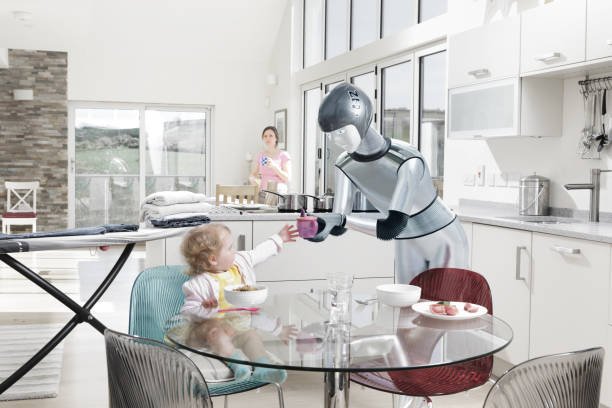
1X Technologies, backed by OpenAI, has unveiled NEO, the world’s first consumer-ready humanoid domestic robot, capable of folding laundry, tidying rooms, retrieving objects, opening doors, and switching off lights — all upon human command or self-learned schedule.
For the first time, humanity stands face to face with its mechanical reflection, not in the laboratory or battlefield, but in the kitchen, bedroom, and living room.
This moment is not technological alone; it is metaphysical — a redefinition of labour, intimacy, and being itself.
2. From Imagination to Incarnation: The Technological Leap
What distinguishes NEO from earlier robotics efforts — Boston Dynamics’ Atlas, Honda’s ASIMO, or Toyota’s T-HR3 — is not merely its dexterity, but its domestication.
Embodiment: NEO stands as a fully formed humanoid, with tendon-driven limbs, 22 degrees of freedom in its hands, and the ability to lift up to 68 kg — built not for industry but for intimacy.
Intelligence: It integrates large-language-model cognition (similar to ChatGPT) to understand speech, learn preferences, and perform adaptive reasoning. It sees, listens, and remembers.
Quiet Efficiency: Operating at just 22 decibels, it moves through human space unobtrusively — a technological whisper.
Autonomy: Though human teleoperators may guide early models, the ambition is self-learning, continuously improving household fluency through interaction and observation.
These developments mark the first tangible realization of embodied artificial intelligence — where metal and code merge to perform human tasks in real-world contexts.
3. Between Utility and Utopia: The Human Condition Re-examined
The rise of domestic robots raises profound questions that transcend engineering. It touches on the essence of work, the dignity of labour, and the architecture of the human home.
3.1 The Meaning of Labour in an Automated Age
Throughout human history, labour has been both burden and blessing — the means by which we shape the world and affirm our existence.
When robots assume the household’s burdens — sweeping, washing, organizing — do they liberate us or displace us?
In Western industrial societies, automation may free the overworked. But in the Global South, where domestic work sustains millions, the robot threatens livelihoods and redefines economic identity.
The Ugandan maid, the Kenyan houseboy, the Nigerian nanny — will they find new purpose, or become casualties of an algorithmic revolution imported from Silicon Valley?
Thus emerges a philosophical paradox:
“The same hand that lifts the weight of labour may crush the soul that depends upon it.”
This calls for Yowerinomical thinking — an economic philosophy rooted in pragmatic transformation, where technology serves humanity, not replaces it.
4. Privacy, Personhood, and the Question of Agency
A humanoid robot in your home is not just a servant; it is a sensor.
It sees, hears, and processes everything.
Each act of assistance doubles as an act of surveillance.
Euronews has already cautioned that NEO may rely on remote human tele-operators for task supervision. This implies that a stranger — perhaps thousands of miles away — could see into your kitchen or bedroom through the robot’s eyes.
This transforms the home — humanity’s most sacred private space — into a data zone.
The boundaries between the personal and the programmable, the intimate and the algorithmic, begin to blur.
The moral question thus shifts from what robots can do to what they should be allowed to know.
In African epistemology, the home (ekibanja, enju, luwo) is sacred. It is where ancestry, memory, and moral formation occur. Introducing artificial agents into that sacred geography demands not only technical safety but cultural consent.
5. The Triple Certainty Lens: Time, Death, and Tax in a Robotic Age
Let us revisit the triad of human certainties — Time, Death, and Taxation — through the lens of robotics.
5.1 Time: The New Currency of Civilization
The robotic revolution promises to buy back human time — the hours spent cleaning, scrubbing, and cooking.
Yet, time without purpose is emptiness.
If we redeem hours only to waste them in digital distraction, then the robot will have freed our hands but enslaved our minds.
A wise civilization must therefore educate for purpose, not just convenience. The time robots save must be invested in creation, not consumption.
5.2 Death: The Machine as Caregiver
As the world ages, robots may prolong life by aiding the elderly, monitoring health, and preventing domestic accidents.
Yet they cannot offer compassion. They cannot grieve with the dying, nor celebrate with the living.
When the touch of a robot replaces the touch of a child, we risk surviving longer — but living less.
5.3 Taxation: The Redistribution of Automation
If robots take over human labour, who earns, and who pays?
Nations must confront the question of a “robot tax”, to redistribute the wealth created by automation and cushion displaced workers.
The domestic robot must not become a new tool of class division — where the rich are served by machines and the poor by unemployment.
6. Africa’s Position: Passive Consumer or Proactive Co-Creator?
Africa must not repeat the pattern of technological dependency — adopting Western machines without shaping their moral, social, or economic direction.
6.1 Contextual Adaptation
Uganda’s households differ from California’s. Our homes are multigenerational, our chores communal, our spaces unpredictable. Robots must be redesigned for African realities — capable of operating on irregular power, understanding African languages, navigating complex cultural cues.
6.2 Policy and Regulation
Government must preemptively develop robotics governance frameworks:
Safety and liability standards for domestic robots.
Data protection and household privacy safeguards.
Reskilling programs for displaced domestic workers.
Incentives for local robotics manufacturing and software localization.
6.3 Ethical Education
African universities must introduce robotics ethics and human–machine philosophy — not as imported curricula, but as indigenous dialogue.
In Ubuntu jurisprudence, “I am because we are.”
Can this ethic extend to the mechanical “other”?
Can a robot be part of Ubuntu?
These are not merely technical inquiries; they are existential ones.
7. Towards a Philosophy of Human–Machine Coexistence
The arrival of NEO does not end the human story; it extends it.
Every civilization must decide whether technology will enhance humanity or erase it.
The Lubogo position is clear:
Technology must serve human flourishing, not human replacement.
We must resist both technological romanticism (believing robots will solve all problems) and technological fatalism (fearing inevitable domination).
Instead, we must cultivate technological humanism — where machines are partners in progress, guided by ethical intellect and cultural conscience.
8. The African Dream in the Age of Robotics
Imagine a Uganda where:
Robots assist the elderly in rural villages.
Schools teach robotics through the lens of African communalism.
Domestic labour evolves into robotics management and AI maintenance.
Robots speak Luganda, Lusoga, or Swahili.
The African home remains sacred, not surveilled.
That vision demands intellectual sovereignty — the courage to think for ourselves in an age of artificial intelligence.
9. Epilogue: When Metal Learns to Serve, Humanity Must Learn to Lead
The humanoid robot folding your laundry is not just a machine; it is a mirror.
It reflects who we have become — clever, restless, and godlike in creation, yet uncertain in purpose.
If we teach robots how to work, we must also teach ourselves how to live.
If we give machines intelligence, we must cultivate wisdom.
And if we invite them into our homes, we must first understand our own humanity — for only the wise can command the intelligent.
“The future is not mechanical; it is moral. The robots have arrived, but the question remains — have we?”